


Chemistry never really stays still. Around the turn of the twentieth century, folks in laboratories around Europe started seeing value in what happens when you tweak basic hydrocarbons. Toluene-4-sulphonic acid—often called para-toluenesulfonic acid (p-TsOH)—emerged out of that rush to understand aromatics. As dye and pharmaceutical industries expanded, they chased after new reagents that could either spark reactions or shepherd molecules from one step to the next. p-TsOH proved itself in those early days because it did a lot of what sulfuric acid did, but with a less aggressive attitude. These old texts and faded German patents tell a story of slow and steady improvement, especially once manufacturing worked out how to scale up sulfonation using fuming sulfuric acid and separate the solid product from the murky mixtures.
In the world of organic chemistry, you find p-TsOH as white to colorless crystals. People rely on its dry form because it’s more stable and doesn’t come with the wet fussiness of some other strong acids. The power of p-TsOH comes through its ability to donate a proton and toss around a sulfonate group, letting it serve as both a catalyst and a helper in a wide stretch of chemical reactions. Unlike some liquid acids, this solid lets lab hands weigh it on a balance, bottle it easily, and toss it into all sorts of glassware without fear of splattering burns.
p-TsOH has a melting point right around 103 °C. You open a bottle, and you’re greeted by hygroscopic flakes—pulling in water vapor with every moment the lid is off. Dissolves well in water, with that exothermic kick that can fog up a flask. Anyone mixing it in solvents notices it vanishes into many alcohols and ethers. The acid packs quite a punch, with a pKa close to -2.8, so it doesn’t mess around in proton transfer. Its structure hangs a sulfonic acid group off the para position of a toluene ring, which matters a ton for its properties—basic enough to avoid wrecking most glassware but strong enough to rival traditional mineral acids.
Chemists who stock up on this molecule want to see purity above 99%. Color can give away lingering iron or byproducts, so the best grades stay bright and nearly transparent. Product labels should always show the CAS number (104-15-4), molecular formula (C7H8O3S), and standardized hazard warnings. Packing usually stays tight, with bottles lined to keep humidity out, and bulk versions come in drums with seals to stop accidental leaks. Correct labeling means fewer accidents and faster audits, something you don’t consider until something goes wrong. Transport and storage demands match those of any strong acid—ventilated, dry, and away from incompatible bases or oxidizers.
Synthesis comes down to sulfonation. You take toluene and run it with fuming sulfuric acid, usually under a hood with the fans roaring. Engineers worked out over the years that keeping temperatures under control stops runaway side reactions. Modern plants often rely on continuous reactors for better yields and tighter impurity control. The reaction mixture gets cooled and the crude product crystallizes. Filtration and repeated washing strip out sulfuric acid, and then drying finishes the work. Quality relies on controlling reactant ratios, reaction time, and temperature. Plants that cut corners end up with discolored, smelly solids—something nobody wants in a fine chemical plant or an upscale lab.
In the reactions where p-TsOH finds its name splashed across research papers, its main job often stands as catalyst. It speeds up esterification and acetal formation, helping turn alcohols and acids into esters or protect carbonyl groups efficiently. In labs that handle peptide synthesis, p-TsOH helps salt precious molecules without contaminating the mixture with too much mineral acid. Chemists sometimes modify the acid itself by making salts—like the sodium or ammonium versions—to tune solubility, or they might tether the sulfonate group to polymers for recyclable acid catalysts. Its benzene ring lets adventurous researchers put more functional groups on, turning it into a launching point for even stranger molecules used in dyes or specialty chemicals.
People who handle this molecule long enough hear it called a dozen different ways: para-toluenesulfonic acid, p-TSA, or simply TsOH. Trade names sometimes crop up on bulk shipments, though the chemistry world mostly sticks to these abbreviations. In catalogs meant for industry supply, you’ll find it under both the Americanized “p-Toluenesulfonic acid” and UK “p-Toluenesulphonic acid” spellings. Search for any of these and you’ll land on the same product, but always double-check the grade to avoid unlucky surprises.
Nobody who’s handled this stuff forgets the warning: p-TsOH stings skin badly and can make a mess of airways if finely powdered crystals get kicked up. Proper handling means goggles, gloves, and working beneath a ventilation hood. Containers need tight sealing—leave one open and you risk pulling moisture out of the air, which can make the substance clump or start low-level reactions right in the bottle. Storage requires separation from strong oxidizers or organic bases, since mixing those in the wrong way or wrong order can go sideways fast. Spills get treated just like sulfuric acid—neutralizing with base, careful scooping, all the usual protocols. Disposal should always follow chemical waste rules, because mixing it down the ordinary drain isn’t just illegal, it corrodes pipes and causes environmental headaches.
Pharmaceutical companies rely on p-TsOH for synthesizing prescription drugs, often to push along steps that require stable, strong acid catalysis but can’t tolerate sulfuric acid’s brutality. Resin manufacturers count on the process to make ion-exchange polymers, which clean up water in everything from municipal plants to home filters. Paint and coatings chemists use it in making alkyd resins, which give coatings their toughness and sheen. It crops up in the world of perfumes too, especially for reactions where gentler acids would take too long or leave behind unwanted smells. In the food industry, it appears indirectly as a catalyst for processing flavors—not in the food, but helping build the essential molecules behind the scenes. Education and research labs rely on it to teach students about esterification and advanced organic transformations, because it keeps reactions on track and illustrates chemical principles clearly.
Every year, scientific journals fill up with new uses and tweaks on how chemists deploy p-TsOH. Green chemistry research tries to recycle it or graft the sulfonate group onto reusable supports to reduce waste. In biochemistry, p-TsOH’s role shifts toward synthesis of biomolecules—particularly in solid-phase peptide assembly, where its purity makes or breaks a batch. Environmental R&D keeps a close eye on its byproducts, looking for ways to capture or neutralize any waste right at the source. Not all research focuses on building new molecules; some teams aim to design safer ways to handle, ship, or recover p-TsOH from spent mixtures instead of discarding it. I’ve seen university groups compete to make acid catalysts that pack the same punch but break down harmlessly after use, which could someday overtake traditional p-TsOH in volume.
Toxicologists document that p-TsOH can burn skin and eyes, and inhaling powdered forms irritates nose and throat pretty quickly. Chronic exposure hasn’t sparked wide reports of cancer or genetic damage, but high doses in animal testing point toward possible liver and kidney stress. That’s why labs keep safety sheets handy and enforce strict PPE. Environmental studies flagged that spilled p-TsOH acidifies water rapidly and can harm aquatic life, mostly from low pH rather than any exotic metabolic disruption. Wastewater standards put strict limits on discharge for this reason, and cleanup teams use neutralizers on spills as a matter of routine. Regulatory bodies in the US and EU both assign strong warnings, and container labels put pictograms right up front so nobody misses the hazards.
Demand for p-TsOH shows no signs of stalling out. Synthetic chemistry needs strong, solid acids that balance effectiveness and stability, especially as manufacturing shifts toward safer, cleaner processes where liquid mineral acids cause headaches. Research teams keep searching for greener or more selective sulfonic acids, but as of now, few alternatives stack up to the versatility and low cost of p-TsOH. Scale-up plants spend serious resources every year looking for ways to make it without the waste of traditional sulfonation, possibly using electrochemistry or catalysts to cut environmental impact. The pressure rises on recyclability and end-of-life handling—companies that figure out how to recover and reuse p-TsOH will not only lower operating costs, but carve out real environmental credibility in a crowded market. Over the decades, p-TsOH built a reputation as a reliable workhorse. As regulations tighten and new technologies emerge, this acid will probably transform how it’s made, shipped, and used, even while its core chemistry stays true to those first discoveries so many years ago.
Step inside any busy chemical plant or laboratory, and you’ll spot names on containers that most folks never hear about on the street. Toluene-4-sulphonic acid, often called p-toluenesulfonic acid or p-TsOH, is one of those. Not much glamour here—just a white crystal, sometimes seen as a syrupy liquid. But don’t judge by looks. This acid gets right into the trenches of production and makes tough jobs easier with a punch far stronger than vinegar or citric acid.
Ask a synthetic chemist how to turn a tangle of simple stuff into a fancy compound, and they’ll often point toward strong organic acids to get things rolling. p-TsOH helps chop up molecules, stitch them together, and strip away the leftovers. It drives classic reactions like esterification: mixing an alcohol and an acid to create sweet-smelling esters used in flavors, perfumes, and solvents. Mineral acids like sulfuric acid can do the job, but they can be harder to separate from the end product or might chew up sensitive compounds. p-TsOH goes gentler on certain molecules, remains soluble in common solvents, and washes away without fuss.
The world of medicines needs careful, reliable chemistry. p-TsOH finds work here both as a catalyst and as a helper to purify drugs. Making antihistamines, antibiotics, and other medicines often involves delicate steps that don’t tolerate much corrosion or side reactions. This sulfonic acid steps in to help make salts of drug molecules, boosting their stability and shelf life. Similar logic shows up in dye factories, where precision counts just as much; one misstep ruins the color. p-TsOH’s strong acidity and gentle hand help push reactions to their goal without splashing unwanted color into the batch.
Every useful tool carries risk. Handling p-TsOH wrongly can burn skin and eyes, or worsen existing chemical hazards in the shop. Companies train workers to keep safe—using gloves, goggles, and fume hoods to keep the acid away from skin and lungs. Waste also demands care. Wash too much down the drain and local water treatment plants might struggle, since this acid can harm aquatic life. Responsible disposal shapes a big piece of the chemistry world. Teams look for ways to reuse acids, neutralize leftovers, or swap in greener options, like enzymes or milder acids, but the old standbys like p-TsOH often hang on due to their hammer-like efficiency and low cost.
Better chemistry shapes a cleaner world. The people behind these acids know each shortcut and pitfall from long hours in the lab. Digital monitoring, closed systems, and advanced personal protective gear lower the risk of spills or inhaling fumes. Green chemistry researchers work on alternatives that cut the need for strong acids in the first place. Still, toluene-4-sulphonic acid keeps its spot in the toolkit, working behind the scenes in manufacturing plants, small labs, and even art conservation. Each year brings better insight on balancing utility with safety, proving that scientific know-how doesn’t just build things—it also keeps people healthy and the environment cleaner.
Toluene-4-sulphonic acid stands out both in classrooms and in industrial labs. Its formula, C7H8O3S, reveals a toluene ring joined to a sulfonic acid group at the fourth position. That tiny change in structure – the addition of sulfonic acid to a benzene ring – brings out all sorts of interesting chemistry. Some remember first encountering it in college, watching clear crystals dissolve with ease, or seeing it listed in synthesis protocols with roles that looked complicated on paper but proved simple with experience.
Toluene-4-sulphonic acid or p-toluenesulfonic acid offers practical benefits in everyday chemical work. In simple terms, chemists use it as an acid catalyst, a role it handles thanks to its strong acidity and solubility in organic solvents. That balance gives reactions a boost without dragging water into the mix. Anyone who has tried esterification or dehydration knows water can kill a reaction; having an organic soluble acid like this keeps things running. In labs producing dyes, pharmaceuticals, and perfumes, this compound keeps showing up for good reason.
A solid grounding in lab protocols matters a lot with any acid. Toluene-4-sulphonic acid may not sound as dangerous as sulfuric or hydrochloric acid, but it can burn skin and damage eyes just as quickly. Wearing gloves and goggles always makes sense. Even small spills require thorough cleanup because its solid form is easy to scatter unnoticed. Keeping containers sealed, working in ventilated areas, and using appropriate neutralizing agents are direct steps that anyone in the lab should know well.
Chemists paid less attention to waste streams decades ago, but priorities shifted. With toluene-4-sulphonic acid, the environmental effect comes from its persistence in water and potential toxicity to aquatic life. Responsible labs neutralize spent acid and follow strict waste handling rules. Industrial plants now treat their effluent more carefully, investing in better filtration and monitoring. This approach makes a real difference for river and lake health downstream from chemical plants.
Many of those working with chemicals learned good habits from mentors. Not everyone has that support. More open, easy-to-follow training reduces risks for new users and helps experienced ones avoid careless mistakes. Visual guides, hands-on workshops, and regular safety audits could help more people work confidently with compounds like toluene-4-sulphonic acid. Sharing stories about near-misses or spills encourages others to stay alert, too.
Researchers continue to look for catalysts that offer similar performance with less hazard or easier disposal. Some new acids based on organocatalysts or reusable polymer beads have potential. Switching to greener processes where possible brings long-term benefits, though cost and performance matter on the ground. Companies willing to invest in sustainable chemistry set an example for their competitors, often drawing support from both regulators and customers interested in cleaner manufacturing.
The chemical formula C7H8O3S packs both challenge and opportunity. Learning how to handle toluene-4-sulphonic acid well makes chemistry safer and more rewarding, both in academic settings and on the plant floor. Those small lessons, picked up over time, build real expertise—benefiting everyone down the line.
Toluene-4-sulphonic acid lives on a long list of chemicals used in industry and the lab, yet the question about its safety has a simple answer. Handling it without care brings serious trouble. This stuff looks like a solid, white powder, almost innocent at first glance. People use it for things like making dyes or medicines. Despite the plain appearance, safety goggles are not for show. Even someone with steady hands gets a rude awakening after skipping gloves.
This acid carries some hefty baggage. Splash it on the skin, and irritation flares up almost at once. Eyes sting hard, sometimes demanding a trip to the clinic. Breathe in the dust, and you’ll find coughing’s only the start—the airways react fast. One time during graduate school, a classmate swung open the reagent jar too quickly. After a cough fit and streaming eyes, nobody forgot the lesson. Its effect is not guesswork; the data backs it up—material safety datasheets list it as corrosive. Pouring from one jar to another without a fume hood means rolling the dice with your lungs.
Even small spills grow worse quickly if ignored. Unlike some acids that give off choking fumes, the threat here comes straight from handling the powder. Small, airborne particles pose a danger even if you think you’re safe, especially in poorly ventilated spaces. People who work with this acid day in and day out cannot rely on habit alone. Carelessness lands you in the emergency room or forces weeks off work to let burns recover. Some industries focus on stricter measures. Workers often get extra training and regular reminders about safety. I’ve met chemists who mention yearly retraining, emphasizing gloves, face protection, and lab coats with fitted cuffs.
Ignoring the label or missing a warning sign puts others at risk—labmates, cleaners, anyone who enters the work area afterward. Spills linger, and if they’re not handled fast, the next unlucky person stumbles into trouble. Safety showers and eyewash stations get used more than people admit. Good habits beat luck. I saw one careless moment ruin someone’s week. They thought a quick cleanup with bare hands would save time, then spent hours at occupational health.
Manufacturers do not try to make handling easy for a reason. Their packaging all but begs you to read the warnings. Routine ventilation checks and proper storage keep exposure down. Chemical-resistant gloves—the kind with solid thickness—make a difference. Goggles never get old. I’ve learned more from slips than from manuals. Sometimes, simple changes work best: double-checking labels, organizing chemical shelves, keeping acids away from bases, and never handling powders near your face.
Toluene-4-sulphonic acid brings value to industry and research, but experience teaches respect. Even if most days pass without a hitch, one mistake with this acid stings—sometimes for a lifetime. Stay cautious, lean on proper training, and nobody has to learn tough lessons the hard way.
Walking into a lab or chemical warehouse, spotting a drum labeled "Toluene-4-Sulphonic Acid" often brings up safety first. This chemical, sometimes called p-Toluenesulfonic Acid, gets plenty of use as a catalyst in organic synthesis, especially for making pharmaceuticals, dyes, and resins. Its benefits show up in its strong acidity and solubility in water and organic solvents. Those features make it helpful but also mean storage cannot be an afterthought.
Leaving any strong acid lying around invites trouble. Toluene-4-sulphonic acid stands out for its hygroscopic nature; given a chance, it draws moisture right out of the air. I’ve seen batches that clumped into bricks overnight just from exposure to humidity. Moisture combinations can lead to caking, contamination, or even slow decomposition, which risks quality loss for any chemical process downstream.
Coughing or eye irritation kicks in quickly with dust from this acid, even in small amounts. Spills create sticky problems, so good storage doesn't just protect the acid — it protects the people working nearby. Look at reported incidents worldwide: lack of proper closures or poor environmental controls led to leaks. Proper storage cuts these accidents down and keeps productivity up.
The best spot for Toluene-4-sulphonic acid sits away from direct sunlight and doesn’t face temperature swings. Heat speeds up chemical changes, and sunlight can break down many acids over time. My preference always goes to a well-ventilated, cool, and dry spot. The storeroom or cabinet should maintain low humidity, ideally below 50%. I once worked with a team that installed silica gel packs in chemical cabinets—this simple fix reduced moisture problems right away.
Use strong, airtight containers made of glass or high-density polyethylene. Other plastics or metals can react over time with strong acids, so check compatibility. After every use, the lid must close tight — even small gaps let in enough moisture to start problems. Avoid keeping p-Toluenesulfonic acid near bases or oxidizers. Vapors and spills from other containers can set off unexpected reactions, singing eyebrows or worse.
Every drum or bottle deserves a clear label, showing both the name and relevant hazard warnings. Workers come and go, and someone in a rush might not remember every code. Visual reminders help prevent mix-ups. Restrict access to people who know what they’re handling. Accidents go up when untrained hands get involved.
Set up a monthly schedule to check seals, containers, and storage conditions. Catch leaks, bulges, or crusty residue before they become bigger problems. Have spill kits on hand, focusing on neutralizing acids and cleaning up safely. Everyone in the facility should know emergency contacts and cleanup procedures. Practice drills can save real injuries later.
Quality and safety depend on a simple formula: airtight containers, dry and cool environments, clear labeling, and trained hands. By following these steps, not only does Toluene-4-sulphonic acid last longer and work better, but labs stay safer and more productive. Chemical storage will never be glamorous, but it pays off every day.
Toluene-4-sulphonic acid lands on the shelves of chemical suppliers in more ways than one. A lot of what shapes its journey comes down to where it’s heading and how people work with it on a daily basis. In my work with industrial projects, it’s rare to find a one-size-fits-all approach for acid packaging. Bulk shipments matter for big manufacturers, but not every user has the storage or need. Over time, I noticed the smartest choices keep both safety and process efficiency in mind—something anyone who’s dealt with chemical workflows will appreciate.
For bulk users, you’re likely to see it packed in HDPE drums, usually between 25 to 200 kilograms. Plenty of industrial plants prefer these for their stability and ease of handling with equipment like drum trolleys or forklifts. Some factories handling large-scale processes arrange for 1000-liter intermediate bulk containers (IBCs) to receive bigger loads with less frequent restocking, which helps lower material handling risks. I once watched a team work with several pallets of these drums, and even with good logistics, it’s clear the container is as important as the acid itself. If those drums fail, clean-up or hazard response gets expensive fast.
Toluene-4-sulphonic acid doesn’t just come as a fluid; it enters warehouses as granules or white crystalline powder, too. This all makes sense since manufacturers look for purity and storage that holds up over time. Bags lined with polyethylene, double-layer sack packaging, or smaller fiber drums show up at specialty chemical outlets and research supply stores, often in sizes from as little as a kilogram up to 25 kilograms. High-grade material, especially for lab or pharmaceutical work, stays in moisture-proof or vacuum-sealed bags to stop the product from clumping or picking up water. As anyone running quality control can point out, a ruined batch from moisture exposure wastes money and trust.
Throughout the logistics chain, regulation and documentation travel with toluene-4-sulphonic acid as much as the acid itself. I recall the long checklists—UN numbers, hazard labels, shipping documentation, and constant training reminders for those handling both deliveries and waste streams. There’s good reason for this: the acid’s corrosive properties put it right on the list of substances where slip-ups can injure staff, damage infrastructure, or trigger regulatory fines. Even packaging design tries to minimize risk; thick-walled plastic drums resist rupture. Security tapes, batch labeling, and lot numbers help trace problems if they ever come up.
Solutions don’t always jump out at you, but over time, working closely with suppliers who track traceability and meet local laws makes a real difference. Leaning on national and global Hazard Communication Standards, like GHS or REACH, reduces confusion for teams on the receiving end and improves emergency preparedness. The safest warehouses have plans for leaks, with personal protective equipment and neutralization kits close at hand and plenty of staff training behind their smooth operations.
Realistically, every packaging choice balances safety, cost, and how the product will get used. Single-use packs reduce contamination, but create more waste. Bulk delivery routes cut logistic costs but raise the stakes for spill response and staff training. I see a push for tamper-evident seals and improved labeling making steady progress, which directly supports both compliance and worker protection. As environmental standards tighten, conversations grow about smarter container reuse and recycling programs. With more chemical handlers pressing for supplier accountability, those packaging details don’t just protect users—they help build a safer, more responsible chemical industry.
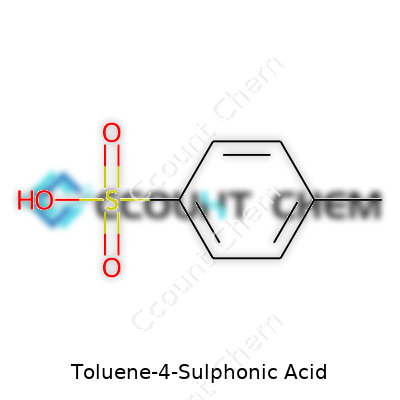
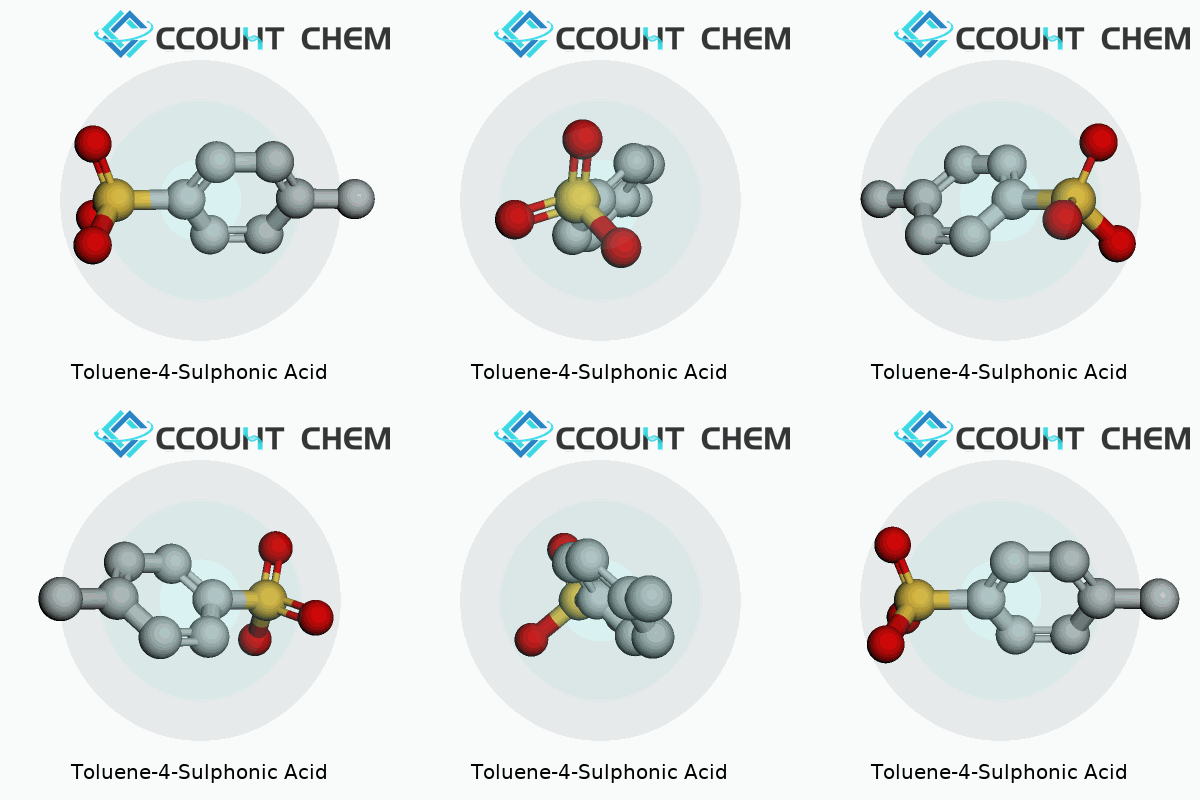
| Names | |
| Preferred IUPAC name | 4-methylbenzenesulfonic acid |
| Other names |
p-Toluenesulfonic acid PTSA Tosic acid p-Toluolsulfonsäure 4-Methylbenzenesulfonic acid |
| Pronunciation | /təˈluːiːn fɔːl sʌlˈfɒnɪk ˈæsɪd/ |
| Identifiers | |
| CAS Number | 104-15-4 |
| Beilstein Reference | 1909405 |
| ChEBI | CHEBI:28718 |
| ChEMBL | CHEMBL15906 |
| ChemSpider | 53383 |
| DrugBank | DB14087 |
| ECHA InfoCard | 03d74e6c-5e68-4d51-84c4-cee6e0c78849 |
| EC Number | 211-361-5 |
| Gmelin Reference | 80337 |
| KEGG | C00534 |
| MeSH | D014034 |
| PubChem CID | 8718 |
| RTECS number | WN5600000 |
| UNII | 38W2LD2F4N |
| UN number | UN2585 |
| CompTox Dashboard (EPA) | DTXSID3023502 |
| Properties | |
| Chemical formula | C7H8O3S |
| Molar mass | 172.20 g/mol |
| Appearance | White crystalline solid |
| Odor | Odorless |
| Density | 1.24 g/cm³ |
| Solubility in water | Soluble in water |
| log P | -2.1 |
| Vapor pressure | 0.01 hPa (20°C) |
| Acidity (pKa) | -2.8 |
| Basicity (pKb) | -6.5 |
| Magnetic susceptibility (χ) | -62 × 10⁻⁶ cm³/mol |
| Refractive index (nD) | 1.586 |
| Viscosity | 30 - 40 cps |
| Dipole moment | 5.10 D |
| Thermochemistry | |
| Std molar entropy (S⦵298) | 168.0 J·mol⁻¹·K⁻¹ |
| Std enthalpy of formation (ΔfH⦵298) | -887.8 kJ/mol |
| Std enthalpy of combustion (ΔcH⦵298) | -3445 kJ/mol |
| Hazards | |
| Main hazards | Corrosive, causes severe skin burns and eye damage, harmful if swallowed, causes respiratory irritation. |
| GHS labelling | GHS02, GHS05, GHS07 |
| Pictograms | GHS05,GHS07 |
| Signal word | Danger |
| Hazard statements | H315, H318, H302 |
| Precautionary statements | P264, P280, P301+P330+P331, P305+P351+P338, P310 |
| NFPA 704 (fire diamond) | 3-1-2-Acid |
| Flash point | 35 °C |
| Autoignition temperature | 280 °C |
| Lethal dose or concentration | LD50 oral rat 2480 mg/kg |
| LD50 (median dose) | LD50 (median dose): Oral rat LD50: 2480 mg/kg |
| NIOSH | WF3150000 |
| PEL (Permissible) | PEL (Permissible Exposure Limit) for Toluene-4-Sulphonic Acid: 5 mg/m³ (as total dust) |
| REL (Recommended) | 2 mg/m³ |
| Related compounds | |
| Related compounds |
Benzenesulfonic acid Toluene Sulfanilic acid p-Toluenesulfonyl chloride o-Toluenesulfonic acid Sulfanilamide |



