


Chemists first prepared sodium 3-nitrobenzenesulphonate in the late 1800s, chasing better dyes and color fastness in the booming textile industry. The early synthetic dye pioneers leaned heavily on aromatic sulfonates, looking for molecules that could cling to fabrics and stay vibrant through countless washes. After nitrobenzene itself popped up as a building block in both dyes and explosives, it was only a matter of time before researchers went down the road of sulfonation and nitration, optimizing for molecules like sodium 3-nitrobenzenesulphonate. European chemical giants rapidly scaled benzenesulphonate technology in the early 1900s, with the molecule soon hopping across industries—moving from silk factories to pharmaceutical labs—demonstrating surprising staying power against countless chemical innovations. Over a century later, the backbone built by these early discoveries still informs how modern chemical manufacturers think about utility, simplicity, and scale.
Sodium 3-nitrobenzenesulphonate doesn’t show up with the fanfare of consumer chemicals, but its impact runs deep in the laboratory and on the manufacturing floor. In everyday work, it serves as a strong, water-soluble intermediate—one that brings nitro and sulfonate groups to a single ring, offering up useful reactivity. Most folks in chemical processing or research don’t see it sitting on a shelf for long; it's blended, transformed, pushed through reactors as both a reagent and a starting material for bigger, more specialized molecules. Markets use this chemical for making dyes, brighteners, and sometimes even as an additive to tweak chemical reactivity in other industrial syntheses.
At first glance, sodium 3-nitrobenzenesulphonate comes as a slightly yellow to off-white powder or granular solid. It dissolves easily in water, a benefit for handling and downstream reactions. The nitro group carries hefty polarity and supports some interesting redox chemistry, while the sulfonate sticks strongly to water molecules and helps spread the compound evenly throughout aqueous solutions. A melting point over 300°C keeps it stable during tough heating and drying steps. With a chemical formula of C6H4NO5SNa and a molecular weight near 225 g/mol, this compound resists easy breakdown in mild conditions, allowing for safe storage if kept dry and away from excess heat or strong acids. Anyone in a working lab will appreciate that it doesn’t carry the volatility or fire risk of many other nitro aromatics.
Product coming from reputable suppliers usually promises purity above 98%, with impurities tightly controlled, especially possible traces of other nitrobenzene derivatives and unreacted starting material. Labels on commercial drums lay out the molecular formula, batch number, date of manufacture, and safety hazard warnings aligned with local chemical regulations. Producers run regular quality checks under ISO and GMP standards, as even slight cross-contamination or degradation can throw off downstream synthesis, especially in sensitive dye or pharmaceutical applications.
One common route starts with sulphonation of nitrobenzene, usually using concentrated sulfuric acid under controlled heat and pressure. Labs add sodium hydroxide to neutralize the mixture, forming the sodium salt and ensuring the end product’s water solubility. The whole process relies on careful temperature management; the aromatic ring needs just the right conditions to pick up the sulfonate accurately at the 3-position, avoiding unwanted isomers or overreaction. Process engineers must dial in reaction time and pH, then run solvent washes and filtration to purify the end product. Their know-how keeps the product efficient, safe, and reproducible across batches.
In synthetic chemistry, sodium 3-nitrobenzenesulphonate opens doors for both reduction and nucleophilic aromatic substitution. I have seen it reduced over hydrogen with palladium catalysts to create amino derivatives, which then act as key stepping stones for specialty dyes and pharmaceuticals. The electron-withdrawing nitro and sulfonate groups work together to make the ring more reactive toward nucleophiles, so skilled chemists often swap them out or build onto them with relative ease. The nitro group offers access to azo coupling, a critical step in dye manufacture, and can be chemically remodeled into other functional groups for diversity in synthesis.
Chemicals often hide behind a patchwork of synonyms, and sodium 3-nitrobenzenesulphonate is no exception. Companies and catalogs list it under names like "meta-nitrobenzenesulfonic acid sodium salt," "3-nitrobenzenesulphonic acid sodium salt," or simply "sodium m-nitrobenzenesulfonate." Keeping tabs on CAS numbers reduces confusion, allowing researchers to order the right product without surprises.
Anyone handling sodium 3-nitrobenzenesulphonate should respect its chemical power, especially in powder form. In the lab, I always reach for gloves and goggles, working under a vented hood even though it isn't wildly volatile. While it doesn't catch fire as easily as many nitro compounds, dust and spills do present exposure risks, mainly irritation and, less often, sensitization. Material safety data sheets set clear expectations for storage—dry, cool, and away from incompatible chemicals like strong oxidizers or acids. Emergency wash stations should sit close by. Proper training pays off, as even experienced teams stay vigilant about lab hygiene and never leave handling to chance.
The reach of sodium 3-nitrobenzenesulphonate stretches from dye houses to cleanrooms. Textile manufacturers care about it for direct and acid dye synthesis, where it gives depth and lasting color. Laboratories turn to it as a template in organic transformations, where fine control of functional groups means higher yield and reliability. Water treatment facilities sometimes test it as a marker or pH indicator, using the sulfonate’s strong ionic character. In my own bench work, I’ve seen it serve as a linchpin in building new aromatic compounds, offering a reliable handle for further functionalization when crafting specialty intermediates for pharmaceuticals.
New generations of chemists keep tweaking sodium 3-nitrobenzenesulphonate—modifying it, building on it, and probing its limits in green chemistry. Research trends test replacement of hazardous solvents in preparation steps, the use of catalytic systems for higher energy efficiency, and renewed interest in its bioactivity. Some R&D teams challenge the classic reaction steps, swapping caustic chemicals for more benign reagents without hurting yield or purity. Improved analytical techniques—like advanced chromatography and mass spectrometry—help researchers catch even low-level byproducts that once slipped below the radar, raising product integrity and safety for human and environmental health.
Data points from animal studies and workplace exposure logs reveal that sodium 3-nitrobenzenesulphonate carries less acute toxicity than many relatives in the nitroaromatic world, but caution persists. Chronic exposure remains poorly mapped, and researchers probe links to skin and respiratory irritation through both animal tests and epidemiological tracking. Newer in vitro toxicity models promise faster, animal-free testing to determine precisely how this molecule interacts with cell membranes and metabolic pathways. Government agencies—like the EPA and ECHA—push for fuller risk assessments, especially for communities near manufacturing plants, nudging companies toward transparency in handling, waste reduction, and emission controls.
Emerging technologies look to sodium 3-nitrobenzenesulphonate as both a known quantity and a puzzle with more potential. Advances in green chemistry urge producers to overhaul synthesis for less waste, lower energy, and safer byproducts. Research groups dive into structure-activity relationships, searching for tweaks that build better dyes, push new drugs, or unlock sustainable applications like water purification membranes. Digital workflows and machine learning now help chemists predict reactivity, making it faster to design follow-on compounds or spot issues before scale-up. For everyone from seasoned researchers to junior techs, tackling new questions around sodium 3-nitrobenzenesulphonate means looking both to the past and the horizon, sharpening safety, efficiency, and innovation at every step.
Sodium 3-nitrobenzenesulphonate has earned a solid reputation in several industrial fields. Its structure—a nitro group attached to a benzene ring with a sulfonate group—gives it specific chemical properties. These features make it more than just a technical curiosity. Factories and laboratories across the globe rely on it for practical reasons, driven by real needs and outcomes.
Walk into any textile plant or printing workshop and you’ll quickly run into colorants that don’t come from nature. Many of the bright, lasting dyes on fabrics or paper trace back to agents like sodium 3-nitrobenzenesulphonate. This compound acts as an intermediate, helping produce azo dyes. These dyes dominate the textile and paper industries due to their durability and vibrancy. People often overlook the chemistry behind their favorite shirts or posters, but much of it depends on intermediates like this one. By improving dye processes, sodium 3-nitrobenzenesulphonate helps workers avoid inconsistent shades and poor colorfastness that used to plague cheaper goods.
Chemical research thrives on reliable building blocks. In my experience visiting research labs, scientists spend hours searching for compounds that give predictable outcomes. Sodium 3-nitrobenzenesulphonate shows up as a reagent to introduce sulfonate groups or to help modify nitrobenzene derivatives. Reactions that may otherwise stall move forward smoothly with it in the mix. Labs value its solubility in water and stable characteristics, both of which simplify handling and storage.
The pharmaceutical sector takes a keen interest in synthetic intermediates. While many compounds might serve similar roles, sodium 3-nitrobenzenesulphonate helps efficiently build more complex molecules needed for drugs. I’ve seen teams rely on this kind of chemistry to speed up synthesis steps; the results aren’t always headline-grabbing, but the cumulative gains speed up medicine development and lower production costs. Fast, reliable reactions also mean fewer contaminants at the end, leading to cleaner products and less waste.
From my work with environmental technicians, I’ve learned that handling chemicals brings real risk, especially in large-scale settings. Sodium 3-nitrobenzenesulphonate requires respect—direct contact can irritate skin, and spills draw strict scrutiny. Plants now use sealed systems and improved training to manage hazards, addressing regulators’ and workers’ concerns. Disposal also matters. Dumping unused chemicals down the drain isn’t an option; treatment facilities have to handle sulfonated waste streams by neutralizing or capturing byproducts before water leaves the site.
For anyone in chemical or manufacturing roles, safety and sustainability set the agenda. Researchers now look at greener synthesis pathways and recycling methods for compounds like sodium 3-nitrobenzenesulphonate. These changes won’t erase its role but may alter how factories source and dispose of it. By embracing safer alternatives and process tweaks, industries carve out a place for modern chemistry that takes people and planet into account too.
Sodium 3-nitrobenzenesulphonate does more than just claim a long name in the world of chemistry. The formula for this compound is C6H4NO5SNa. I spent plenty of late nights in college deciphering formulas like this, and each one means something. Breaking it down, it’s built from a benzene ring decked out with a nitro group at the third position, a sulfonic acid group, and a trusty sodium atom riding along to balance out the charges.
Formulas aren’t just squiggles and letters in a book. Sodium 3-nitrobenzenesulphonate shows up in many industries, especially in dyes and pigments. This chemical gives color to fabrics and plays a role in photography and organic synthesis. Without a clear formula, managing quality or safety gets risky. Anyone who’s ever been in a lab knows how a small change in structure can turn something safe into a hazard. I once saw an accident where a misread formula led to an unexpected reaction. Lessons like that stick for good reason: details matter, especially in chemicals that end up in consumer goods.
Chemists rely on precise structures to predict how a substance will behave. For sodium 3-nitrobenzenesulphonate, that means knowing it has six carbons, four hydrogens, one nitrogen, five oxygens, one sulfur, and a sodium atom. That specific combo means the compound dissolves well in water, carries a negative charge at the sulphonate end, and holds potential for further reactions. It differs from its potassium cousin only by the sodium part, so small swaps change things more than most people realize.
Recognizing a chemical’s formula protects both workers and end users. With sodium 3-nitrobenzenesulphonate, knowing the exact composition prevents accidental exposure and supports proper disposal. This chemical, thanks to its sulfonic group, usually doesn’t vaporize quickly or travel through the environment unchecked, but it can linger in water. I saw guidelines shift at my old research job after incidents of contamination in a local river. That prompted extra scrutiny for chemicals containing sulfonic groups, including this one.
Clear records back up safety standards in manufacturing, storage, and transport. Regulatory bodies like the European Chemicals Agency track compounds like sodium 3-nitrobenzenesulphonate and require accurate data on their formulas. Chemists, engineers, and inspectors all count on the right data to do their jobs safely. Fact-checking against trusted databases, peer-reviewed publications, and Material Safety Data Sheets makes a big difference. My own work in quality control hammered home that lesson. Checking the label is just a start; what’s inside needs to match the chemistry on paper too.
Research continues on how to make synthetics and their byproducts safer, from improving spill response to designing less persistent alternatives. Training workers on reading formulas and understanding reactivity offers a real boost in day-to-day safety. For local labs and big industry, sticking to formulas like C6H4NO5SNa isn’t just about getting the color right or keeping a reaction steady. It’s about keeping people safe, delivering reliable products, and staying on the right side of regulations. Everyone from students to professionals wins with a little extra attention to the details.
Raw chemicals spark conversation every day, especially those used broadly in industry or research. Sodium 3-nitrobenzenesulphonate shows up in labs and factories, from dye-making to specialty chemical blends. Plenty of folks who handle it wonder about the risks. A name this long sounds concerning, so the right approach involves digging into what it actually does to people and the world around us.
Experience in the chemistry lab has taught me to respect every compound until proven otherwise. Safety data tells part of the story. Acute toxicity studies, mostly on animals, show moderately low toxicity for sodium 3-nitrobenzenesulphonate itself. Most folks won’t get sick by touching it, although it’s not something to rub on your skin or breathe in for fun. The compound may irritate skin, eyes, or the respiratory tract if dust forms. It tastes bitter and leaves an acrid smell, both signals to avoid contact.
Digging into research, there’s no solid evidence that it causes cancer or affects reproductive health, at least not at levels found in controlled work environments. Regulations say plenty about other nitro-aromatic substances, some of which do cause serious health problems in the long run. This group's track record means nobody should downplay the risk if spills or chronic exposures happen.
What sets one workplace apart from another is the system for handling hazards. Years spent managing chemical inventories made clear that hazard labels don’t always prepare people for real mishaps. Sodium 3-nitrobenzenesulphonate needs common-sense handling. Basic gloves, lab coats, and goggles take care of casual splashes or dust. Ventilation stops airborne particles from ending up in your lungs. Local exhaust setups above benches keep the air safe—something no label can replace.
Factory storage makes a difference too. Keeping the chemical away from acids and strong reducers avoids unexpected reactions. I’ve seen over-packed shelves of similar-looking powders lead to confusion and near misses. Clear labels and separate spaces for each material make memory slips far less likely, saving trouble later.
Everything poured down a drain belongs to the planet, not just the worker or employer. Sodium 3-nitrobenzenesulphonate, like many aromatic sulfonates, resists breaking down in typical treatment plants. Some studies show bacteria can tackle it eventually, given the right setup, but high loads throw off sewage systems. If enough escapes, water creatures suffer. Fish exposed to similar chemicals show stress or dieoffs, especially where regulation falls behind usage.
Nobody should ignore proper waste disposal. Collection bins for chemical leftovers and spent solutions cost little compared to a cleanup or legal case. Tracking how much comes in and goes out counters “it wasn’t much” excuses. It’s easy to believe a spoonful won’t matter, but repetition scales up every risk.
Documentation from bodies like the European Chemicals Agency keeps improving, as more data trickles in from years of use. Safety habits tend to lag behind breakthroughs. Real protection means keeping up with what regulators and scientists find. Updating protocols, training staff on changes, and sharing near-miss stories at shift meetings help everyone pay attention. If we rely only on tradition or memory, the odds favor accidents sooner or later.
Chemistry’s benefits often carry risks, and sodium 3-nitrobenzenesulphonate offers another example. Careful respect for this compound—grounded in evidence, not fear—lets its good uses outweigh its downsides. The best way to stay safe is to assume nothing, check the facts, and act with purpose every step of the way.
Handling chemicals like sodium 3-nitrobenzenesulphonate is serious business. Each storage mistake with a compound like this can cost more than money; it can threaten safety and set back research or industrial processes. I’ve worked with similar sulphonated chemicals, and a little care at the storage stage can go a long way toward smoother, worry-free usage later. Anyone who’s spent time in a lab probably remembers a leaky container covered in mystery powder—lessons in chemical stewardship often come sprinkled with a healthy dose of caution.
Sodium 3-nitrobenzenesulphonate, like many specialty chemicals, comes with guidelines straight from safety data sheets. Most labs keep it in tightly sealed containers, kept away from moisture and direct sunlight. I’ve seen firsthand how humidity sneaks through even the tiniest cracks, especially during the summer. Dampness clumps powders together, sometimes leading to clogs or even strange reactions. That’s why a dry, cool shelf—ideally inside a dedicated chemical cabinet—makes a real difference. While refrigerators work for some chemicals, moisture from cooling cycles can become a bigger risk for substances sensitive to water.
Chemical compatibility is more than a chart on the wall. Storing sodium 3-nitrobenzenesulphonate in glass or high-grade plastic jars keeps contaminants out. I’ve seen folks try to cut corners with cheaper plastics, but that seldom ends well. Some plastics degrade or react over time. That can mean ruined samples or damage to the container, risking exposure or spills—problems that nobody wants to clean up. The chemical’s slightly acidic or oxidative profile also means cheap metal lids or shelving might corrode, so I always check storage gear for signs of rust or residue.
Every facility worth the name keeps reactive chemicals apart. Too many stories involve incompatible substances like strong acids or bases stashed side by side. One careless shelf arrangement can create dangerous cross-reactions. At one university lab, a minor mix-up between labeled sections led to weeks of inventory checks and heightened stress. Keeping sodium 3-nitrobenzenesulphonate with similar sodium sulphonates works best, but always keep oxidizers and reducers far apart according to written protocols. It only takes one mistake to remind everyone why those protocols exist.
Clear, honest labeling takes the guesswork out. Each container should carry the full name, concentration, and hazard notes—no room for shorthand or fading labels. I always add the date received. Inventory tracking matters, because some chemicals degrade faster than others. If a shelf holds containers with peeling labels or faded writing, it tells me there’s a bigger management problem. For those in teaching labs or larger teams, a central logbook or digital record helps cut down on hunting for missing bottles or scrambling to find what’s still in date.
Good storage habits save time, money, and sometimes lives. Instead of overhauling entire systems, I’ve found small measures—like regular audits, humidity sensors, or even a monthly walk-through—can keep storage areas safe. New team members benefit from a quick tour of storage spaces and a rundown of relevant safety checks before they even open a container. Careful stewardship echoes across the workplace, setting a standard everyone can follow.
Sodium 3-nitrobenzenesulphonate often shows up as a pale yellow powder, catching attention from researchers and industry workers for its unique characteristics. This compound carries both a nitro group and a sulfonate group, both prized in organic chemistry for the reactions they unlock. Its water solubility isn’t some background data point; it’s a key factor that determines how well it does its job across different settings—whether in dye manufacture, laboratory analysis, or as an intermediate in chemical syntheses.
One thing stands out quickly: sodium 3-nitrobenzenesulphonate dissolves readily in water. At room temperature, you can expect it to reach a solubility level in the neighborhood of 500 grams per liter. This number might impress anyone who’s tried to mix less-friendly organics into water. Water, pulling those sodium ions and sulfonate groups apart, helps the compound go smoothly into solution, making it a practical choice for applications that can’t tolerate undissolved particles or sluggish mixing.
This ease of dissolution traces directly back to its structure. The sodium sulfonate end loves water, breaking down into ions with almost no fuss. The nitro group, attached firmly to the aromatic ring, doesn’t block this process. For anyone mixing up solutions in a lab or on a much larger production scale, the job gets much simpler—you don’t wait ages or crank up the temperature just to make it budge.
The high water solubility opens up options. Whether working with dyes, searching for test reagents, or running chemical syntheses that ask for tight controls, being able to dissolve sodium 3-nitrobenzenesulphonate easily means operations move faster and more reliably. In my time supporting a water-treatment team, using highly soluble chemicals has meant less risk of clumping, faster reactions, and cleaner outputs. Solids that float around undissolved pile on troubleshooting headaches, so ease of solution makes everyone’s day smoother.
Environmental engineers and toxicologists count on this too. A chemical that jumps eagerly into water will distribute itself faster in spills. Good record-keeping about these figures helps first responders know how to plan a cleanup. Wastewater plants, for example, keep close tabs on what comes in, and a soluble chemical lets their equipment flush contaminants away with fewer snags.
There’s a flip side: high solubility means care is needed with containment. An accidental spill can send sodium 3-nitrobenzenesulphonate slipping into local rivers and lakes faster than less-soluble cousins. Environmental testing and monitoring systems should stay up to date with detection limits and response plans. Water treatment teams can explore activated carbon systems or advanced oxidation approaches, using published removal efficiencies to design smarter processes that pick up fast-moving soluble compounds before they spread too far.
People across fields—manufacturing, research, environmental work—lean on solubility data every day. Good laboratory tests, careful records, and responsible equipment design turn that knowledge into safe, productive work. More collaboration between industry specialists, environmental scientists, and regulatory bodies will help balance productivity with safer chemical handling. Solubility sits at the crossroads of convenience and responsibility, putting the challenge—and the chance for progress—directly into our hands.
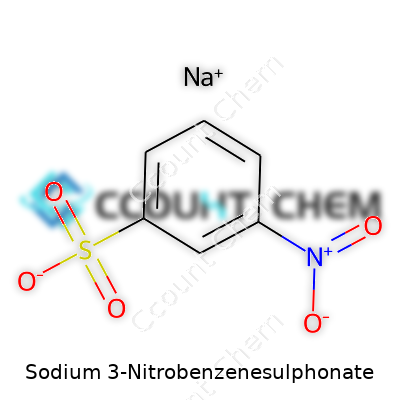
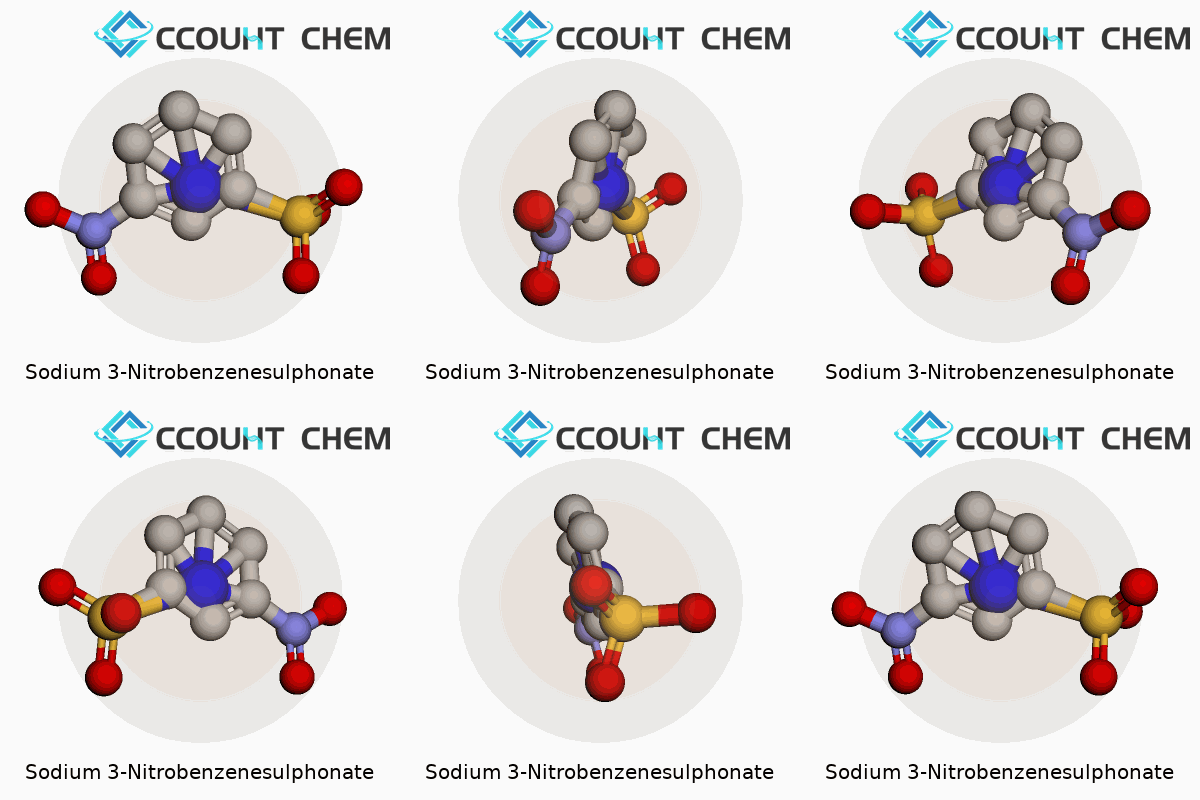
| Names | |
| Preferred IUPAC name | Sodium 3-nitrobenzenesulfonate |
| Other names |
Sodium m-nitrobenzenesulfonate Sodium 3-nitrobenzenesulfonate Benzenesulfonic acid, 3-nitro-, sodium salt |
| Pronunciation | /ˈsəʊdiəm θri ˌnaɪtrəʊˌbɛnˈziːnˌsʌlˈfəʊneɪt/ |
| Identifiers | |
| CAS Number | 127-68-4 |
| Beilstein Reference | 1718737 |
| ChEBI | CHEBI:87659 |
| ChEMBL | CHEMBL3560609 |
| ChemSpider | 14452 |
| DrugBank | DB04318 |
| ECHA InfoCard | 100.026.963 |
| EC Number | 247-675-2 |
| Gmelin Reference | 112063 |
| KEGG | C18875 |
| MeSH | D017960 |
| PubChem CID | 84959 |
| RTECS number | TT8225000 |
| UNII | X3KQ12G7G3 |
| UN number | UN2818 |
| CompTox Dashboard (EPA) | DJ1K902M86 |
| Properties | |
| Chemical formula | C6H4NO5SNa |
| Molar mass | 259.13 g/mol |
| Appearance | Light yellow to brown crystalline powder |
| Odor | Odorless |
| Density | 1.58 g/cm³ |
| Solubility in water | Soluble in water |
| log P | -2.7 |
| Vapor pressure | Negligible |
| Acidity (pKa) | -2.8 |
| Basicity (pKb) | 11.3 |
| Magnetic susceptibility (χ) | -41.0e-6 cm³/mol |
| Refractive index (nD) | 1.527 |
| Dipole moment | 3.68 D |
| Thermochemistry | |
| Std molar entropy (S⦵298) | 318.6 J·mol⁻¹·K⁻¹ |
| Std enthalpy of formation (ΔfH⦵298) | -499.6 kJ/mol |
| Pharmacology | |
| ATC code | A05BA08 |
| Hazards | |
| Main hazards | Harmful if swallowed, causes serious eye irritation |
| GHS labelling | GHS02, GHS07 |
| Pictograms | GHS07 |
| Signal word | Warning |
| Hazard statements | H302, H315, H319, H335 |
| Precautionary statements | P280, P305+P351+P338, P337+P313 |
| NFPA 704 (fire diamond) | 1-2-0 |
| Explosive limits | Non-explosive |
| Lethal dose or concentration | LD50 oral rat 2480 mg/kg |
| LD50 (median dose) | LD50 (median dose): 2000 mg/kg (oral, rat) |
| NIOSH | WN1200000 |
| PEL (Permissible) | PEL (Permissible): Not established |
| REL (Recommended) | 10 mg/m³ |
| Related compounds | |
| Related compounds |
Aniline Benzenesulfonic acid m-Nitroaniline m-Nitrobenzenesulfonic acid Sodium benzenesulfonate |



