


Experience has shown that tracing chemicals like potassium 1,1,2,2,3,3,4,4,4-nonafluorobutane-1-sulphonate means diving into the broader story of fluorinated compounds. The quest for ever-more robust and resilient surfactants, especially after the environmental reckoning over PFOS and PFOA, paved a pathway for molecules with shorter fluorocarbon chains. Chemists in the post-2000 era focused hard on molecular tweaks that could keep the desirable properties of legacy PFAS, but with a profile less prone to environmental persistence. Laboratories in Europe and Asia, where pressure to find replacements reached fever pitch, led much of the charge. Across regulatory meetings and technical conferences, nonafluorobutane-1-sulphonate appeared with increasing frequency, stamped by manufacturers hoping to skirt bans and meet new safety benchmarks.
People familiar with specialty chemicals see potassium nonafluorobutane sulfonate as a salt where a highly-fluorinated carbon chain links to a sulphonate group, with potassium helping keep the molecule water-soluble. Offered mostly as a white crystalline powder, it pops up in catalogs aimed at laboratories chasing next-generation electronic materials or special application surfactants. What sets this chemical apart isn’t just structure; it reacts reliably and retains many desirable surface-activity features found in its longer-chained cousins, without drawing the same environmental scrutiny.
Potassium 1,1,2,2,3,3,4,4,4-nonafluorobutane-1-sulphonate stands out in a laboratory for its resilience. It resists acids, bases, and most heat-catalysed breakdown processes. This molecular fortitude has roots in the carbon-fluorine bonds. At room temperature, it keeps a stable, non-volatile presence. Its high solubility in water and select polar solvents stems from the sulphonate group, while the perfluorinated tail repels oils and nonpolar liquids. Its melting point hovers around 250°C, and decomposition only truly starts above that, usually producing corrosive or toxic gases. In terms of handling, static charge can pose a headache—powdered forms tend to cling, so operators wear grounded gloves and use metal scoops.
Specification sheets for this potassium salt highlight purity levels, particle size, moisture limits, and residual solvents. Industry-standard expectations keep impurities—like free acid or organic solvents—well below one percent. Labels include the full IUPAC name, the formula C4F9SO3K, and hazard information adapted from GHS requirements. Batch numbers and manufacturing dates help with traceability, especially because agencies in Europe and North America now demand detailed records to track fluorinated materials' movement across borders. Companies steer clear of ambiguous naming, instead sticking to unambiguous terminology to avoid regulatory penalties. Dust hazard warnings take a prominent spot, as fine particles can irritate the lungs.
Synthesizing potassium nonafluorobutane sulphonate requires a multi-step process, generally starting with nonafluorobutanesulfonyl fluoride. This intermediate gets neutralized with potassium hydroxide, yielding the desired salt following purification. Each step demands attention to temperature, reaction times, and moisture exclusion. Many labs opt for stainless steel reactors; glass can fail under the corrosive burden of intermediates. After neutralization, careful washing and drying remove side products and prevent caking. The process leaves behind a solid that can be ground, sieved, and tested for consistency before packing. Over the years, manufacturers have automated much of this workflow to keep purity levels consistent and minimize cross-contamination.
Potassium 1,1,2,2,3,3,4,4,4-nonafluorobutane-1-sulphonate rarely engages in redox reactions, but it can participate in nucleophilic substitutions, facilitating the introduction of other functional groups onto fluorinated backbones. This reactivity, paired with the sulphonate’s ability to act as a leaving group, allows chemists to build derivatives used in specialty polymers and as precursors to materials with tailored wetting properties. My experience working on lithium battery electrolytes showed me just how crucial a tweak to a sulphonate group can be. Even a minor modification shifts solubility, performance, and environmental profile. Unlike more volatile PFAS, this molecule resists alkaline degradation, making waste management tougher and demanding specialized treatment.
Industry catalogues reference this material as Potassium perfluorobutanesulfonate and PFBSK. Regulatory documents sometimes swap in C4F9SO3K or use the alternative Perfluorobutanesulfonic acid, potassium salt. For all practical purposes, distributors stick to names tightly mapped to its chemical structure, driven less by branding and more by the need to comply with local and international labeling codes. Chemical supply databases flag cross-references to CAS numbers to cut through confusion, especially since differing regional laws sometimes call for explicit mention of “potassium” to differentiate from sodium or ammonium salts.
Factories and research labs working with potassium 1,1,2,2,3,3,4,4,4-nonafluorobutane-1-sulphonate enforce close attention to safety. Workers suit up in protective gloves, goggles, and lab coats. Even modest spills on skin trigger long rinses and incident reports. Air handling equipment scrubs dust from work zones, and HEPA filters stand between research benches and HVAC intakes, catching fine particulate that could otherwise linger. Most internal safety manuals repeat warnings about avoiding incompatible chemicals, especially strong bases or acids that might corrode containers. Emergency showers and spill kits—packed with neutralizing agents specific for fluorinated materials—wait near doorways. Proper waste drums, labeled as PFAS-containing, ensure regulators can track storage and disposal across the supply chain without missing a batch.
The actual utility of potassium 1,1,2,2,3,3,4,4,4-nonafluorobutane-1-sulphonate spills across industrial, laboratory, and even consumer-product sectors. Electronics manufacturers use it in etching solutions because its chemical resilience fits cleanroom settings prone to aggressive washes. I’ve seen it specified in the formulation of firefighting foams, chosen after the usual suspects faced phase-out for environmental concerns. Some textile processors add it to finishing baths, banking on its oil and water-repellent qualities to create stain-resistant clothing. Analytical chemists lean on it in trace detection work—its unique fluorinated structure stands out from background signals in mass spectrometry. Each application leans heavily on the molecule’s blend of stubborn stability and momentary activity.
Chemists in industry and academia experiment with this compound to balance out the tightrope between performance and environmental stewardship. Recent research saw focus shift from mere replacement of legacy PFAS to full lifecycle impact, with questions about environmental breakdown, human exposure, and remediation featuring front and center. Research groups, especially in North America and Northern Europe, work under the watchful eye of shifting regulations, updating material safety dossiers and investing in analytical techniques that track low-level contamination in water, soil, and air. Innovation comes in bursts—faster, more cost-effective synthesis routes; new modifications; improved detection and cleanup tools.
No one in the field shrugs off the toxicology of potassium nonafluorobutane sulfonate. Short-chain PFAS like PFBSK draw closer scrutiny than ever, and even though early animal studies suggest they bioaccumulate less than their long-chain relatives, they still resist breakdown. Public health bodies in the US and EU lean on peer-reviewed literature that documents potential links to thyroid disruption and liver toxicity in repeated exposures. Chronic low-level dosing in rodent studies highlights subtle but measurable impacts. Labs study everything—from zebrafish to human cell cultures—in an effort to paint a risk profile regulators and companies can use. Despite the heated debate, consensus still leans toward precaution, with many groups calling for limits and phased-out use in non-essential applications.
Calls for sustainable chemistry challenge every stakeholder, and future prospects for potassium 1,1,2,2,3,3,4,4,4-nonafluorobutane-1-sulphonate reflect this pressure. Research aims to strip down further environmental impact, find suitable alternatives, and tighten up disposal routes to avoid the mistakes that made PFAS such a dirty word. Innovations that improve breakdown or open up ways to recycle or neutralize the compound are already in pilot testing. Industry-watchers see this salt only as a step toward the next generation of specialty chemicals—those whose benefits don’t always come with an environmental price tag. Regulations truck on, and demand for transparency pushes companies and labs to share data more widely, so every new material faces sunlight before it ever leaves the bench.
Potassium 1,1,2,2,3,3,4,4,4-nonafluorobutane-1-sulphonate sounds like something straight out of a chemistry textbook, but this chemical has been quietly shaping products and processes people use or encounter every day. Behind the long name sits a member of the group known as per- and polyfluoroalkyl substances, or PFAS for short. These chemicals have earned the nickname "forever chemicals" because they’re nearly impossible to break down in the environment.
In the world of industry, this potassium salt most often gets used for its ability to repel water, oil, and dirt. I’ve seen factories depend on similar PFAS-based compounds to give textiles, carpets, and upholstery impressive stain resistance. Workers handling these coatings know how much mess a spilled drink or drop of oil can cause on untreated fabric—so these chemicals feel like a safety net. Potassium 1,1,2,2,3,3,4,4,4-nonafluorobutane-1-sulphonate fits into that toolkit, sprayed or applied during processing to help surfaces resist contamination.
That’s not the end of the story. Firefighting foam is another major use. Over the years, dozens of airport and military crews have depended on these foams to snuff out fuel fires fast. These chemicals deliver—they form a stable barrier that suffocates flames. In that job, nothing else replaces PFAS compounds quite as effectively, at least not right now. Some electronics manufacturers also value this potassium salt for its role in circuit board creation, where it helps prevent unwanted chemical reactions.
People living near industrial sites often don’t see the benefits of PFAS. Instead, they feel the impact when these substances end up in drinking water. Studies tie PFAS exposure to higher risks of certain cancers, immune issues, and developmental problems. The U.S. Environmental Protection Agency has sounded alarms about water contamination linked to chemicals from this family, and new research keeps raising red flags.
From where I’m standing, the cost of relying on something that barely breaks down outweighs the comfort it provides in our sofas or hazard suits. Cleanup is expensive. And doctors can’t sweep away years of exposure with a prescription or quick fix. Some farmers near manufacturing plants watched their livestock get sick, and the food chain doesn’t draw neat boundaries—humans often eat what animals absorb.
Regulators across Europe and North America have started restricting or banning PFAS use in certain products. Health agencies want manufacturers to prove that alternatives work just as well, but also carry less risk. From my own reading, companies now research plant-based coatings, silicone derivatives, and even old-school beeswax for waterproofing jobs. Firefighters test fluorine-free foams. Results show potential, but there's still no perfect, universal drop-in replacement.
Switching away from PFAS doesn’t call for only government action. It takes honest conversations in boardrooms and with frontline workers. The people who invent these substances need to own the lifecycle. That means tracking where the stuff travels, reporting spills, and investing in cleanup and better recycling. Shoppers play a part, too, by choosing products with clear safety credentials.
No single fix stands out, but the push for transparency, tighter rules, and new science offers real hope. That’s what will cut our shared risks, even if we can’t see these chemicals gathering in tap water or slipping into the soil under our shoes.Potassium 1,1,2,2,3,3,4,4,4-nonafluorobutane-1-sulphonate — a name that sounds like it belongs in a chemistry journal, not kitchen conversation. For most people, this substance lives behind the scenes, tucked inside technical data sheets or buried in the fine print of industrial supply chains. The stuff deserves attention, though. It’s part of a group of compounds known as perfluoroalkyl substances, or PFAS. These “forever chemicals” stick around in soil, water, wildlife, and people longer than anyone expected.
The big story behind PFAS is persistence. Instead of breaking down like most things, these substances hang around for decades. Potassium 1,1,2,2,3,3,4,4,4-nonafluorobutane-1-sulphonate doesn’t just vanish after a spill or a rinse. Its bonds are so strong that sunlight, water, or bacteria hardly touch it. I can remember talking with a water technician who said, half in jest, these compounds “will outlive us all.” That kind of staying power means small releases come back to haunt drinking water, crops, fish, and, ultimately, dinner tables.
People who spend time researching public health worry about PFAS. Decades of study link other PFAS, like PFOS and PFOA, to cancer, immune system changes, higher cholesterol, and developmental issues in kids. The World Health Organization and the US EPA both highlight serious risks when human exposure climbs. Potassium 1,1,2,2,3,3,4,4,4-nonafluorobutane-1-sulphonate shares a chemical backbone with these bad actors. Scientific journals, including “Environmental Science & Technology,” connect it with changes in cell function and enzyme performance in laboratory conditions. A human study from China pointed toward kidney and thyroid effects — not proven, but enough to make scientists push for more research.
You won’t find this compound in household cleaners or snack packaging, but it pops up in specialized manufacturing. Electronics, stain-resistant textiles, and firefighting gear sometimes turn to complex PFAS, including this one, to hit performance targets. Workers may breathe it in, splash it on their gloves, or handle that equipment every shift. Community watchdog groups have already started asking about emissions around plants. Water testing in Belgium and South Korea pulled up trace amounts near industrial hubs.
Letting industries clean up their own mess never worked with lead or asbestos, and it likely won’t work here, either. Regulators need to set clear rules on PFAS, track down legacy contamination, and stick with science-based review timelines. The EPA began listing more PFAS for tougher regulation in 2023 — a step in the right direction, but it should move faster and include more compounds. Wastewater treatment technology lags behind PFAS chemistry. Investment in real infrastructure solutions, like high-tech filtration or incineration, beats short-term fixes.
People often hear advice: buy water filters, avoid stain-proofed upholstery, read labels, lobby elected officials. As a parent with kids who love local tap water, trust comes from knowing someone in charge asks tough questions, reads health data, and acts before statistics turn into graveyards. The story of potassium 1,1,2,2,3,3,4,4,4-nonafluorobutane-1-sulphonate isn’t finished, but waiting for disaster before acting can’t be the storyline.
Potassium 1,1,2,2,3,3,4,4,4-Nonafluorobutane-1-Sulphonate draws a lot of attention from lab professionals who care about safety and long-term stability. There’s no way around it: chemicals with multiple fluorine atoms require a real plan for storage. As someone who's clocked countless hours in labs, I know scrimping on careful storage doesn't just lead to loss of expensive material. It can ruin data sets, damage containers, or even endanger colleagues.
Room temperature seems safe for a lot of reagents, but not for every compound. Moisture can sneak in and start breaking down sulphonate salts if containers aren’t tight enough. I’ve seen whole batches clump or degrade just because a seal failed, letting humidity hang around. For Potassium 1,1,2,2,3,3,4,4,4-Nonafluorobutane-1-Sulphonate, dry, air-tight storage keeps the material stable. Desiccators lined with drying agents like silica gel or molecular sieves do a lot of the heavy lifting here. Keep it out of direct sunlight and away from heat sources, since UV and warmth can cause slow decomposition. I’ve learned to treat chemicals with strong fluorine bonds with a lot of skepticism towards light and heat exposure.
Don’t just grab any bottle off the shelf. Regular glass, low-density polyethylene, or polypropylene containers already have proven their value for storing fluorinated salts. Steer clear of metal lids or metal shelving, since accidental reactions or corrosion might surprise you. I try to double-check compatibility charts every time I order new labware, because an overlooked incompatibility can cause both leaks and ruined chemicals. Tight, corrosion-resistant caps with PTFE liners offer an extra layer of security—just one more step to make sure moisture stays out.
Anyone who works in a shared space knows how easy it gets for chemicals to lose their labels, especially with daily wear and solvent splashes. Triple-checking both names and dates on storage bottles helps avoid using compromised or outdated material. For chemicals prone to slow shifts in quality, like this sulphonate, that means always rotating stock and never letting inventory sit forgotten for years. Colleagues should know exactly how old each batch is, and if a container ever gets opened outside the dry-box, a notation should follow.
Potassium 1,1,2,2,3,3,4,4,4-Nonafluorobutane-1-Sulphonate doesn’t release pungent fumes like some acids, so it’s easy to underestimate risks. Chronic exposure to dust or mishandling happens quietly but stacks up over time. I never skip the lab coat, gloves, and goggles routine—even for brief periods in the storage area. Working in a space fitted with local exhaust ventilation, like a chemical fume hood, reduces the chance of inhalation problems if a spill or unexpected release happens. It’s also a good call to keep dedicated spill kits on hand for fluorinated compounds.
Chemicals containing fluorine pose a serious issue for disposal. I’ve watched too many well-meaning labs toss leftovers that could have been used, often because of poor storage. Rethinking chemical usage and ordering smaller amounts can save money while cutting down on toxic waste that must be treated as hazardous. Any substance with persistent, bioaccumulative properties needs professional handling during disposal. It’s not just a workplace rule—it’s for the environment outside those lab walls.
Some chemical names turn into tongue twisters, and Potassium 1,1,2,2,3,3,4,4,4-Nonafluorobutane-1-Sulphonate fits the bill. The real story often hides in the formula. The structure comes down to a butane backbone stripped of many hydrogens, replaced by fluorine atoms, plus a sulfonate group, then paired with potassium. The formula for this chemical reads as C4H2F9KO3S. Seeing this formula on paper tells me this isn’t your typical salt. It’s engineered for serious tasks, most times in labs or industrial zones, not home pantries.
Next question—how heavy is a single molecule here? You figure out the molecular weight by adding up each atom’s contribution. Carbon weighs in at 12.01, hydrogen at a mere 1.01, fluorine brings a hefty 19.00 per atom, potassium at 39.10, oxygen at 16.00, sulfur at 32.07. Take four carbons (4 x 12.01 = 48.04), two hydrogens (2 x 1.01 = 2.02), nine fluorines (9 x 19.00 = 171.00), one potassium (39.10), three oxygens (3 x 16.00 = 48.00), and a single sulfur (32.07). Stack these numbers together and you get a molecular weight of around 340.23 g/mol. This value matters if you’re mixing labs solutions or scaling up in factories—it shapes costs and process controls.
Chemicals like Potassium 1,1,2,2,3,3,4,4,4-Nonafluorobutane-1-sulphonate don’t hang around for no reason. With so many fluorines and a sulfonate tag, folks use it for surface treatment, cleaning up electronics, and sometimes as a surfactant in firefighting foam. The stuff’s not cheap or simple to make. Its persistence in the environment, thanks to all those strong carbon-fluorine bonds, means it doesn’t break down like sugar in water. I’ve been involved in projects where the wrong chemical downstream gummed up works, cost thousands to fix, and left backlogs all because no one checked the fine print on molecular weights and structures.
This class of fluorinated chemicals raises eyebrows across the globe. Read enough studies and you’ll spot concern: high resistance to heat and chemical breakdown sounds great in a lab, but spells trouble in lakes or bloodstreams. Some perfluorinated compounds linger long in organisms, causing health worries from liver damage to hormone disruption. National agencies in Europe and North America have started tracking and even restricting related chemicals. Fact: getting rid of persistent organofluorines costs communities big money.
Knowledge sits at the crux of safer use. Labels with precise formulas and weights empower end users, researchers, and regulators. If you’re using this compound, know where it ends up. Push for greener options, or at the very least, closed-loop systems so it doesn’t float out into open water. Companies need training and transparency; not just to tick compliance boxes, but to protect both workers and the local ecosystem. Clean chemistry takes more legwork but saves headaches down the line—something plenty of teams, including mine, have learned the hard way.
Tracking down a specialized chemical like potassium 1,1,2,2,3,3,4,4,4-nonafluorobutane-1-sulphonate takes more than typing its name into a search engine. Most people don’t hear much about these types of compounds unless they work in research or manufacturing. It helps to remember that using or even ordering a chemical like this usually requires the buyer to have a purpose and the right credentials. Suppliers rarely offer such materials to casual buyers. The gates stay closed unless you know exactly what you need and your paperwork matches up.
This type of compound shows up in environmental studies and sometimes in advanced electronics and water treatment. Labs focused on advanced materials research, especially those looking at perfluorinated chemicals, use it most. Potassium 1,1,2,2,3,3,4,4,4-nonafluorobutane-1-sulphonate isn’t something you find at regular hardware stores or even most university chemical supply rooms. Specialist chemical providers such as Sigma-Aldrich (now part of MilliporeSigma), Alfa Aesar, and TCI America list it within their product lines, but not on open shelves. If they have a stock, they want to know the researcher, project details, and sometimes government registration before shipping it out.
In recent years, governments worldwide have put the squeeze on who buys and sells potent fluorinated chemicals. These compounds fit into a category known as PFAS, or “forever chemicals,” which have raised health and environmental red flags in countless studies by the EPA and related watchdog groups. Handling, selling, and shipping such substances falls under regulatory control for good reason. Where purchases happen, the sales process includes so much paperwork—proof of research intent, compliance with safety standards, and documentation for customs if shipping crosses borders. I remember the hours lost helping a friend set up a legitimate purchase; every step comes with warnings, checks, and legal hurdles. This is not lost time, either. Accidents and unauthorized uses can ruin reputations or worse.
If you represent a lab or a company with good standing, the path runs through those big-name chemical supply firms. Building a relationship helps. Frequent buyers get more straightforward service, especially if orders stick to clear research needs or industrial reasons. Skipping corners in the purchasing process or using shady third parties seldom ends well. Fake sellers or “gray market” providers sometimes advertise online, but they do not deliver, and they create risks for legal blowback or contaminated material. For individuals with no research or business affiliation, the door stays closed, reflecting years of misuse and runaway contamination.
Stories about substances like potassium 1,1,2,2,3,3,4,4,4-nonafluorobutane-1-sulphonate highlight a bigger problem. When I scan headlines about PFAS in drinking water and long-term exposure, it reminds me that regulations grow out of necessity. Supply chain transparency, qualified buyers, and oversight protect more than just researchers. To keep moving forward, the scientific community works with suppliers, not around them. Solutions won’t come from bypassing red tape—they come from clearer communication, stronger accountability, and responsible sourcing, every step of the way.
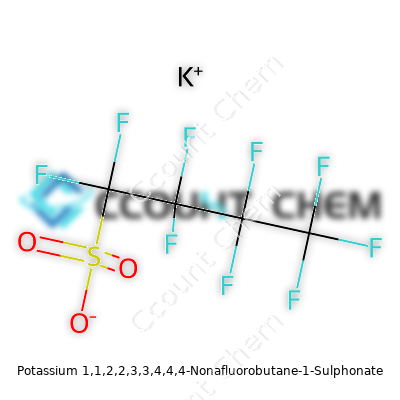
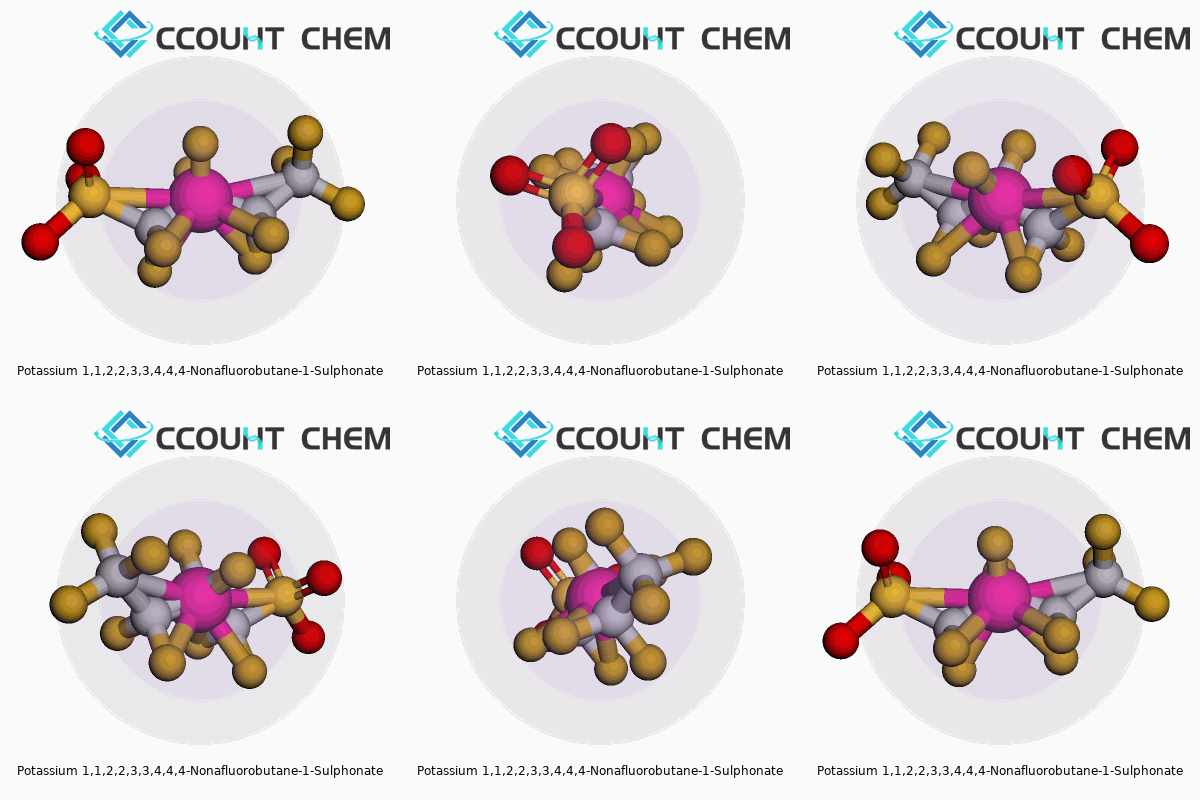
| Names | |
| Preferred IUPAC name | Potassium 2,2,3,3,4,4,4-heptafluorobutane-1-sulfonate |
| Other names |
Potassium nonafluorobutanesulfonate PFBSK Potassium perfluorobutanesulfonate Potassium nonafluorobutane-1-sulfonate |
| Pronunciation | /pəˈtæsiəm ˌnɒn.əˌflʊə.rəˈbjuː.təˌnɒn ˈsʌl.fəˌneɪt/ |
| Identifiers | |
| CAS Number | 29420-49-3 |
| Beilstein Reference | 3208126 |
| ChEBI | CHEBI:141426 |
| ChEMBL | CHEMBL3980677 |
| ChemSpider | 13118899 |
| DrugBank | DB16684 |
| ECHA InfoCard | 03b4b90c-e947-4cf2-8bdd-cddf1f4c3eb8 |
| EC Number | 700-335-8 |
| Gmelin Reference | Gmelin Reference: 34941 |
| KEGG | C15667 |
| MeSH | D000072586 |
| PubChem CID | 10486525 |
| RTECS number | TC7200000 |
| UNII | 2G2ISG0D3X |
| UN number | UN3077 |
| Properties | |
| Chemical formula | C4F9KO3S |
| Molar mass | 326.19 g/mol |
| Appearance | White to off-white powder |
| Odor | Odorless |
| Density | 1.7 g/cm3 |
| Solubility in water | Slightly soluble |
| log P | -2.4 |
| Vapor pressure | Negligible |
| Acidity (pKa) | -4.8 |
| Basicity (pKb) | -11.3 |
| Magnetic susceptibility (χ) | -56.4 × 10⁻⁶ cm³/mol |
| Refractive index (nD) | 1.294 |
| Viscosity | 0.98 cP |
| Dipole moment | 3.49 D |
| Thermochemistry | |
| Std molar entropy (S⦵298) | 373.7 J·mol⁻¹·K⁻¹ |
| Std enthalpy of formation (ΔfH⦵298) | -1606.5 kJ/mol |
| Pharmacology | |
| ATC code | V03AB36 |
| Hazards | |
| Main hazards | Harmful if swallowed. Causes serious eye irritation. May cause damage to organs through prolonged or repeated exposure. |
| GHS labelling | GHS07, GHS08 |
| Pictograms | GHS07 |
| Signal word | Danger |
| Hazard statements | H302, H315, H319, H335 |
| Precautionary statements | Precautionary statements: "P260, P262, P273, P280, P302+P352, P305+P351+P338, P310 |
| Lethal dose or concentration | LD50 Oral Rat > 2000 mg/kg |
| LD50 (median dose) | LD50 (median dose): >2000 mg/kg (rat, oral) |
| PEL (Permissible) | Not Established |
| REL (Recommended) | REL: NIOSH considers 0.01 mg/m³ as a recommended exposure limit (REL) for potassium nonafluorobutanesulfonate. |
| IDLH (Immediate danger) | Unknown |
| Related compounds | |
| Related compounds |
Perfluorobutanesulfonic acid Sodium perfluorobutanesulfonate Potassium perfluorooctanesulfonate Potassium trifluoromethanesulfonate Lithium perfluorobutanesulfonate Ammonium perfluorobutanesulfonate |



