


Long before laboratories filled with pipettes and automated reactors, the story of guanidinium sulphamate began with early chemists digging into guanidine salts and their derivatives. Guanidine, a fairly basic organic compound, first took shape in research circles thanks to its strong nitrogen-based structure. The search for safer explosives and flame retardants put sulphamate derivatives on people’s radar by the mid-twentieth century. The method of combining guanidine sources with sulphamic acid to produce guanidinium sulphamate handled industrial and laboratory needs with more precision than previous techniques. Over time, as purity requirements increased, synthetic strategies saw multiple refinements, giving the world a product treated with reliability and safety in mind.
In today’s market, guanidinium sulphamate steps into several roles—chemical intermediate, flame retardant, and laboratory reagent. It takes shape as a white to off-white crystalline powder, often packaged in moisture-proof containers due to its slight hygroscopic nature. Most packaging has tight labeling to ensure safe storage and clear handling instructions. Every batch reaching academic, industrial, or manufacturing settings comes with data sheets, tracking not just batch numbers but every parameter that could affect use.
Guanidinium sulphamate crystallizes orthorhombically and holds a melting point near 165°C, with decomposition following shortly after. Its moderate water solubility stands out—enough to dissolve efficiently, but not so deliquescent as to complicate storage. The absence of odor, low volatility, and a bright, near-white appearance signal purity for different applications. It delivers a neutral to slightly basic pH upon dissolution, reflecting the guanidine backbone. Reactivity remains low under ambient conditions, but mixing with strong acids or bases and oxidative materials escalates hazard potential.
Labs and manufacturers call for guanidinium sulphamate in grades ranging from technical to reagent grade. Each drum, pouch, or bottle should come stamped with net content, chemical name, supplier info, batch number, and hazard pictograms—aligned with GHS norms. Purity often runs to at least 99%, and impurities like heavy metals, moisture content, and residual starting materials earn sharp scrutiny. Certificates of analysis accompany large-scale supplies to satisfy customer requirements and compliance benchmarks.
Synthesis typically follows a straightforward acid-base reaction. Guanidine carbonate or guanidine hydrochloride meets sulphamic acid in aqueous solution, carefully controlling temperature to avoid runaway reactions or by-product formation. Slow addition and constant stirring give a crystalline mass, which is then filtered, washed, and dried under vacuum to ensure quality. Commercial preparation draws on improved crystallization protocols and solvent selection, minimizing inclusion of foreign ions and controlling particle size for streamlined downstream processing.
In the lab, researchers use guanidinium sulphamate mainly as a mild reducing agent or a flame retardant precursor. Under controlled thermal conditions, it releases nitrogen, making it valuable for energetic material applications. The guanidinium group lends bifunctionality; by tailoring conditions, chemists modify it for custom resins, foams, or as a source in synthesizing complex heterocycles. In fireproofing, modification with other phosphates or halogens increases thermal stability and suppression ability—something not lost on materials scientists or regulatory testers.
Outside the main catalog listing, guanidinium sulphamate answers to a few other names: guanidine sulfamate, guanidinium sulfamic acid salt, and guanidinium amidosulfonate top the chart. Vendors may attach brand-specific prefixes or suffices, but the fundamental product remains recognizable due to its reliable specifications and CAS registry number. Identification across safety sheets and inventory logs rides on these alternate synonyms.
No one should approach guanidinium sulphamate without context. The dust can irritate respiratory tracts and eyes—something I first realized during a hasty weighing session, which taught me why it’s best to keep the chemical under a fume hood and pay attention to PPE. Standard operating procedures include gloves, goggles, and lab coats, plus local exhaust ventilation. SDSs flag irritation risks, so workplace training and spill kits matter as much as fire-resistant storage cabinets. Emergency plans reference possible decomposition gases and the need for specialized cleanup. Frequent audits and hazard communication round out the well-organized lab or plant.
Guanidinium sulphamate softens hardline distinctions between chemistry subfields. In textiles, it advances flame retardancy for fabrics, giving protection in uniforms, furnishings, and even children’s sleepwear. The building industry looks at it for fire safety compliance in insulation materials. In analytic chemistry, its reducing action gets exploited in assays and colorimetric reactions, particularly where less hazardous alternatives to common reducing agents prove valuable. Even metal finishing—especially the passivation of aluminum—takes advantage of its controlled reactivity and by-product benignity. Agriculture and horticulture research watch with care, assessing both efficacy and environmental fate.
R&D in guanidinium sulphamate revolves around enhancing its fire retardancy, compatibility with polyols and binders, and improving environmental friendliness. Emerging markets stress lower toxicity, push for biodegradable or less persistent residues, and keep a close watch on ecological impacts in real-life burn and breakdown conditions. Researchers have also begun tweaking the molecule’s structure—adding bulk, electronic tweaks, or changing solubility—to unlock custom-fit performance for newer high-performance materials. Collaboration between academia and industry fields new composite products, with focus groups, pilot projects, and grant-funded studies tracing every improvement.
Toxicological investigations have cataloged both acute and chronic effects. Inhalation or direct contact can cause irritation, as animal studies and workplace experience show. Environmental toxicologists monitor the aquatic impact, checking persistence and breakdown into non-reactive end products. Chronic exposure routes, including skin absorption or ingestion, take center stage in regulatory filings. I’ve noticed how standard operating guides urge quick first aid responses, decontamination, and medical oversight. Occupational exposure limits now inform better workplace design and shift rotas—protecting workers while maintaining efficiency. Ongoing studies track metabolites and the fate in complex biological systems, hashing out safe-use levels and approval for new applications.
Looking ahead, guanidinium sulphamate holds ground in fireproofing and specialty chemical synthesis. Demand rises in green construction and safer transport materials, shaped by regulatory push and public expectation. Synthesis routes grow greener by cutting waste and hazardous by-products, with labs chasing catalysts to drive efficiency. Industry groups continue seeking blends with better environmental release profiles and resilience under harsh service conditions. Breakthroughs in flame-retardant coatings, biodegradable polymer blends, and low-smoke emission materials trace back to guanidinium sulphamate’s evolving toolkit. Standards and testing will keep pace, guided by hard-won lessons in the field and renewed global focus on workplace and consumer safety. Continued investment in R&D promises safer, smarter materials adapting to tomorrow’s unpredictable challenges.
Some chemicals blend into daily life quietly but pack a big punch behind the scenes. Guanidinium sulphamate falls into that category. From conversations I’ve had with folks in different trades and from my background working with lab reagents and safety data, it’s clear this chemical rarely gets much limelight—yet people rely on it more often than they think.
Walk into any warehouse or workshop—especially those filled with electrical equipment—and you might spot dry chemical fire extinguishers. The powder inside many of those is based on guanidinium sulphamate. Years ago, an electrician showed me how fast electrical fires can get out of hand. Water makes things worse around live wires. Here’s where this compound comes in handy, tamping down fires without conducting electricity or making a mess that destroys equipment. Fire extinguishers need to be reliable. Laboratory tests show this powder cools things off and blocks oxygen, choking out the flames before they can get ugly.
Metal finishing shops care about safety and results. The surface of steel and similar metals collects oxides and scales that weaken the final product. Acid pickling has been around for ages to clean up this mess, but many acids are nasty, corrosive, and dangerous to handle. Guanidinium sulphamate offers a safer route for descaling steel. It strips off rust and scale without eating away at the metal itself or leaving behind dangerous fumes. Spent many hours cleaning up after hydrochloric acid; the residue and smells were harsh. Switching to safer chemicals like this saves headaches and hands.
You sit at a desk full of crisp white paper and probably don’t wonder about the behind-the-scenes chemistry. Bright white, uniform sheets usually mean strong bleaching agents stepped in along the way. Guanidinium sulphamate helps remove lignin, the natural stuff that yellows and darkens paper over time. This function matters for students, office workers, and artists alike. Paper companies look for results that are both cost-effective and environmentally gentler, especially with increasing calls for cleaner production lines. The International Agency for Research on Cancer and groups promoting green chemistry have recognized the value in swapping out harsher, more toxic substances whenever safer options work.
Nothing comes free in chemistry. Guanidinium sulphamate isn’t something anyone should dump down the drain or handle with bare hands. Too many times, poor safety training led to emergency room visits that could have been avoided. Material Safety Data Sheets stress using gloves, goggles, and proper ventilation. Companies take responsibility for waste streams, working with disposal experts so this chemical doesn’t end up in rivers or soil. Scientists and regulators check for long-term effects, but the real key is steady respect and careful storage.
Customers, workers, and companies all push for healthier workplaces. I’ve watched old timers shake their heads at toxic old-school chemicals that hurt more than they helped. Guanidinium sulphamate is one sign that people expect safer tools without giving up on quality. Future developments in this field lean toward even cleaner replacements—bio-based options, smart recycling systems, and equipment that make every grain count.
Fire protection, metal cleaning, and bright paper all depend on good chemistry. Guanidinium sulphamate isn’t a household name, but it stands out for those who care about results and safety at the same time. Trust and expertise, rooted in real use and science, will keep shaping how this chemical—and those like it—fit into everyday work and life.
Guanidinium sulphamate, known for its sharp sounding name, turns up in places ranging from organic synthesis to metal cleaning jobs. Most people have never heard of it unless their hands get close to chemistry labs or certain industrial areas. The big question is: should people worry about it affecting health? Its chemical cousins in the guanidinium family have a reputation for strong reactions, and this compound is no different.
Having spent years exploring both chemical research and safety documentation, I see why workers who handle such materials pause before unscrewing the lid. The compound releases ammonia if it touches heat or acids, and ammonia exposure can burn eyes, skin, or respiratory passages. In the kind of factory or university setting where large amounts get moved around, accidents sometimes happen. Shortness of breath, headaches, and coughing all creep up if ventilation systems fall short or protective equipment gets ignored.
The chemical safety record doesn’t spark much joy. Guanidinium sulphamate irritates eyes and skin, and inhaling fine powders can strike at lung function. Case reports and laboratory studies point to these outcomes, although hard data on long-term chronic exposure barely fills a few pages. Safety Data Sheets from organizations like Sigma-Aldrich or PubChem call for immediate washing of any splashes. Accidental swallowing often means stomach problems or poisoning. Regulatory agencies, including the European Chemicals Agency (ECHA), urge labeling containers with clear hazard warnings, indicating the need for gloves, goggles, and face covers during use.
While most families don’t stock guanidinium sulphamate under the sink, problems start when disposal goes wrong. In my time training students, lab waste sometimes finds its way into regular trash cans. The risk doesn’t vanish once the experiment ends. Workers who handle cleaning and disposal often have fewer resources or training, which puts them at a bigger risk of accidental exposure. Environmental concerns add another layer. Improper dumping contaminates water systems or harms aquatic life. News stories about chemical plants underscore how fast mistakes spread outside their original boundaries.
Limiting hazards calls for practical steps. Every workplace using this compound needs clear, specific training—no one learns chemical safety through guesswork. Gloves and safety glasses belong on hands and faces before the work even starts. Airflow systems should carry fumes away quickly. Spills require quick cleaning and separate containers for disposal help prevent accidents. Well-printed labels and emergency washes remain vital features for safer labs.
Outside industry, environmental agencies must update disposal guidelines so local landfills and water treatment plants stay safe. Research still needs funding to keep up with new uses and to reveal hidden risks, especially for workers with years of exposure. People have a right to know about the chemicals near them, and no shortcut replaces a proper safety plan. Real safety begins in small, thoughtful habits that everyone can follow—inside or outside the lab.
Lab work and chemical storage go hand in hand. Some compounds like Guanidinium Sulphamate seem harmless enough on the shelf—white, powdery, not giving off any smell—but things change once you understand what it does and how it reacts. I’ve watched what happens when people treat chemicals like kitchen spice, tossing jars under any old counter. Sometimes, that leads to nothing. Other times, it turns a quiet storeroom into a safety incident.
Guanidinium Sulphamate absorbs water. Moisture in the air, a leaky ceiling, or a damp shelf can break down the powder or clump it together. The substance loses its reliability, and the results in experiments go haywire. Worse, moisture sometimes speeds up decomposition or helps it react in unexpected ways. I learned this during a summer internship; humidity made the shelves sticky, and more than one chemical lost its punch. Storing Guanidinium Sulphamate away from sinks, windows, or water pipes just makes sense. A dry spot goes a long way. Air conditioners or even silica gel packs inside the storage cabinet can keep excess humidity in check.
I never found it wise to let containers bake in direct sunlight. Chemicals live longer at stable, moderate temperatures. Guanidinium Sulphamate holds up well at room temperature, but it never likes the heat. Going above 30°C begins to nudge things in the wrong direction—decomposition, lost potency, occasionally a little gas release that has no business in an enclosed space. So keeping it in a cool, shaded cabinet, with no direct heat sources, becomes rule number one. Most storerooms with proper ventilation or a climate control system already tick this box.
Some people forget the obvious: Wide-open jars invite problems; airtight containers keep the air and moisture away. Glass and HDPE plastic containers work best; they don’t react to the chemical and keep things simple. Labeling matters. Once, I watched someone mix up a white powder and spent half a day running blank tests because no one labeled it properly. Every container needs a date, a chemical name, and warnings about possible irritants. Chemical safety is about being clear for the next person, not just yourself.
Mixing chemicals never ends well, and Guanidinium Sulphamate shares that bad habit. It reacts with strong acids, strong bases, or oxidizing substances. Storage needs separation. If a spill reaches the wrong neighbor, fires or toxic fumes could result. Simple shelving—acid cabinet here, oxidizers cabinet there, organics on another shelf—reduces the risk. Even experienced hands can get tripped up by a rushed end-of-day closeout. A once-over of where everything sits never hurts.
Good storage comes down to discipline. Safety Data Sheets (SDS) live close at hand. I copied one into a binder I kept next to the storage room, so no one had to dig for info during a spill or emergency. Regular inventories stop expired or decomposing chemicals from sitting around and becoming the next problem. Gloves, splash goggles, and easy access to a spill kit are simple tools that handle almost any mishap.
Getting storage right makes chemical handling safer and reduces waste. It saves money, stops unplanned downtime, and keeps people healthy. Training staff to recognize risks—humidity, temperature, incompatibility—makes them more careful by habit, not just by rulebook. Most accidents I’ve seen weren’t due to complicated science, just overlooked basics. Guanidinium Sulphamate might seem boring, but boring is better than hazardous in any storeroom.
School chemistry books teach us formulas and names, but every compound tends to have a story that matters to more than just students cramming for exams. Guanidinium sulphamate, with the formula CH6N3SO3, is a name that pops up in industry and laboratories. This formula shows how elements combine to make something far from ordinary, packing together carbon, hydrogen, nitrogen, sulfur, and oxygen. The molecule joins the guanidinium ion (CH6N3+) with the sulphamate ion (SO3NH2-).
Anyone who has spent time working in a lab or in industrial settings might recognize guanidinium sulphamate as more than just a textbook answer. Its chemical properties—especially its ability to break down proteins and remove heavy metal ions from solutions—make it valuable in real work. Fire retardant applications and its use in cleaning formulations create safety and environmental benefits. Instead of relying on more toxic substances, companies apply this compound to meet modern safety standards and environmental rules.
Working with chemicals prompts real questions about safety and environmental care. Guanidinium sulphamate offers an option that has a more favorable profile compared to other chemicals used for similar purposes. Data from chemical safety sheets notes that while it’s less toxic, proper handling, protective equipment, and ventilation still matter. From my own experience, the right lab habits save not just skin and lungs, but also the peace of mind that comes with responsible work. Spills or incorrect disposal don’t only hurt people—they affect ecosystems. Efforts to treat waste and neutralize residues put chemical know-how to use for long-term impact.
In industrial cleaning, guanidinium sulphamate stands out for removing rust and scale from metals. Some metal finishers prefer it because it works at lower concentrations and with fewer corrosive effects on the base metal. These features protect equipment and help factories save on maintenance costs. Textile operations also find this compound useful in specific dyeing and treatment steps, caught between the push for strong performance and the pull for safer, less harmful reagents.
Chemicals like this come with big responsibilities. Research in materials science has started to track what happens after such molecules finish their job. Wastewater treatment plants see a range of substances, and the science around removal or neutralization methods keeps evolving. New filtration materials, bio-based cleanup enzymes, and even solar-powered breakdown processes show promise. Industry professionals face decisions every day about disposal and sustainability, so staying informed becomes essential.
Guanidinium sulphamate’s formula may seem like just a string of letters and numbers, but it marks a spot where chemistry moves off the blackboard and into the practical world—enhancing safety, making manufacturing sharper, and helping the environment when managed with care. Concrete knowledge goes a long way in making better decisions, and understanding chemical details supports not only compliance with evolving regulation but also broader stewardship of health and safety standards.
Guanidinium sulphamate pops up on the workbench in labs, factories, and some niche workshops. Its popularity comes from its role as a flame retardant or a chemical intermediate, but it doesn’t come without its dangers. Inhaling dust, getting it on your skin, or mixing it with the wrong stuff can cause harm faster than most people realize. Even after twenty years running lab sessions, I’ve seen folks cut corners on chemical handling, thinking rules just slow them down. But the truth is, chemical burns, lung irritation, and environmental damage don’t really slow down for anyone.
Working safely starts well before you open a container. Gloves that resist chemicals, splash goggles, and a sturdy lab coat should be the bare minimum. Dust from guanidinium sulphamate has a sneaky way of drifting. That means proper ventilation isn’t just a box to tick—it’s about keeping everyone breathing easy. I still remember my early days supervising a team and realizing not one person had fit their mask properly. One quick safety huddle sorted that out, but not everyone is lucky enough to catch problems before something goes wrong.
A spill can make a real mess, and panic usually follows—unless the right gear is nearby. Absorbent pads, dedicated chemical spill pillows, and a large tub of fresh water for emergency rinsing don’t just collect dust in storerooms. They keep panic from spreading. Keeping an emergency shower and an eyewash station within reach isn’t just a “nice to have.” In my own experience, I’ve witnessed what thirty seconds without rinsing can mean for chemical exposure—it isn’t pretty.
Storage rules for guanidinium sulphamate can’t just live on a paper checklist. Acidic chemicals, oxidizers, and anything that can spark a reaction need a safe distance. If a shelf falls or a container cracks, separate cabinets and secondary containment trays keep things from mixing and causing a hazardous mess. A labeled, locked cabinet says a lot about how a workplace values safety. Anyone who’s seen a fire break out because incompatible chemicals met by accident knows how important that separation is.
Pouring leftover chemicals down a drain might seem like a quick fix, but the rest of us see what happens next. Local rivers and soil suffer for small shortcuts. Regulations say guanidinium sulphamate counts as hazardous waste, and it deserves careful attention. Solid residues and empty containers should end up in sealed, labeled drums stored for hazardous waste pickup. Coordinating with certified disposal services isn’t about ticking a bureaucratic box—it’s what protects public health and the local water supply. Cities and towns usually post their own lists of licensed waste handlers; workers just need to check, ask for the right paperwork, and follow through.
I’ve helped train newcomers to treat chemical disposal as a badge of pride, not a chore. Seeing a well-labeled drum headed out for proper disposal gives a sense of a job done right. Each step, from double-checking PPE to signing off on waste manifests, isn’t about paranoia—it’s about playing your part in a longer chain of responsibility.
Formal safety education still works best. Supervisors and workers who can spot gaps in their own process do the best job in protecting themselves—and their neighbors. Clear signage, regular drills, and open communication never feel like wasted effort. No one likes paperwork, but logging exposure times, inventory levels, and near-miss incidents helps people learn and improve. People tend to follow good routines more closely when they see direct results. After all these years, I still believe that teaching safety starts with a real respect for the chemicals we use and the community outside the lab doors.
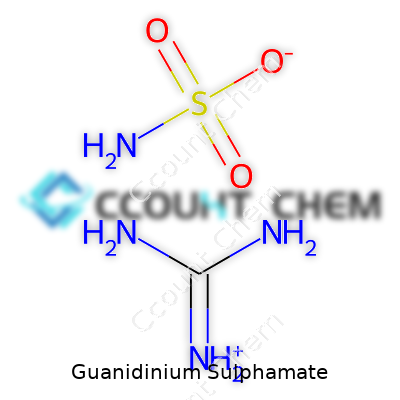
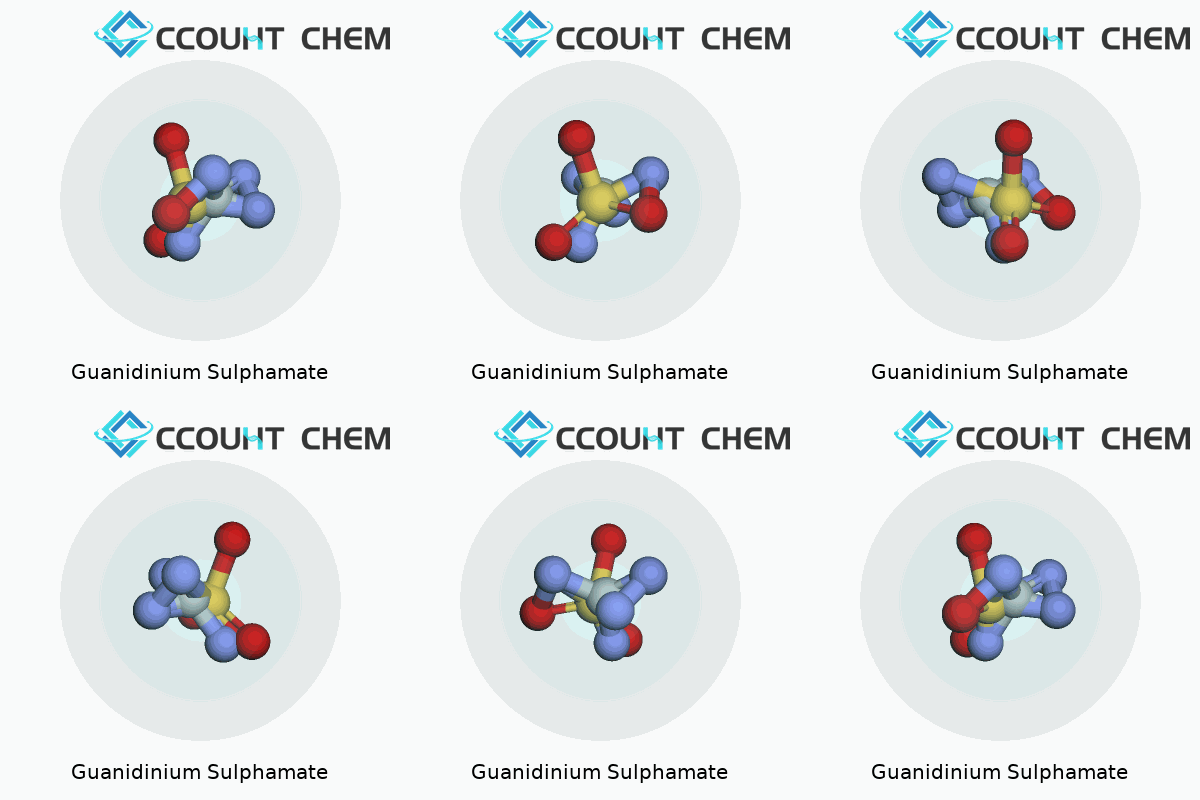
| Names | |
| Preferred IUPAC name | guanidinium sulfamate |
| Other names |
Guanidinium sulfamate Guanidine sulfamate Guanidinesulphamic acid Guanidine sulphamate |
| Pronunciation | /ɡwəˌnɪdɪniəm ˈsʌlfəmeɪt/ |
| Identifiers | |
| CAS Number | 2582-30-1 |
| Beilstein Reference | 3521054 |
| ChEBI | CHEBI:142604 |
| ChEMBL | CHEMBL1230509 |
| ChemSpider | 18829924 |
| DrugBank | DB11391 |
| ECHA InfoCard | 100.043.596 |
| EC Number | 221-133-1 |
| Gmelin Reference | 87319 |
| KEGG | C18638 |
| MeSH | D017556 |
| PubChem CID | 166829 |
| RTECS number | MF4300000 |
| UNII | 5CS23Y99EK |
| UN number | UN1479 |
| CompTox Dashboard (EPA) | DTXSID2020187 |
| Properties | |
| Chemical formula | CH6N4O3S |
| Molar mass | 120.14 g/mol |
| Appearance | White crystalline powder |
| Odor | Odorless |
| Density | 1.41 g/cm³ |
| Solubility in water | Soluble |
| log P | -3.18 |
| Vapor pressure | Negligible |
| Acidity (pKa) | 1.0 |
| Basicity (pKb) | 1.1 |
| Magnetic susceptibility (χ) | -6.1e-6 cm³/mol |
| Refractive index (nD) | 1.506 |
| Dipole moment | 2.12 D |
| Thermochemistry | |
| Std molar entropy (S⦵298) | 196.5 J·mol⁻¹·K⁻¹ |
| Std enthalpy of formation (ΔfH⦵298) | -541.49 kJ/mol |
| Pharmacology | |
| ATC code | V03AB38 |
| Hazards | |
| Main hazards | Harmful if swallowed, causes serious eye irritation, may cause respiratory irritation. |
| GHS labelling | GHS02, GHS05, GHS07 |
| Pictograms | GHS05,GHS07 |
| Signal word | Danger |
| Hazard statements | H302: Harmful if swallowed. |
| Precautionary statements | P261, P280, P301+P312, P305+P351+P338, P337+P313 |
| NFPA 704 (fire diamond) | 2-0-0 |
| Autoignition temperature | 250°C |
| Lethal dose or concentration | LD₅₀ (oral, rat): 1310 mg/kg |
| LD50 (median dose) | LD50 (median dose): Rat oral 1310 mg/kg |
| NIOSH | Not Listed |
| PEL (Permissible) | Not established |
| REL (Recommended) | 500 mg |
| IDLH (Immediate danger) | Not established |
| Related compounds | |
| Related compounds |
Guanidinium nitrate Guanidinium carbonate Guanidinium chloride Sulphamic acid Ammonium sulphamate |



