


Chemicals often earn their place in the laboratory after a journey through decades of research and industrial development. 1-Hexanesulfonic acid sodium salt didn’t just appear one day as a handy reagent; its roots go back to the growing need for reliable ion-pairing agents in chromatographic separation. As chromatography grew from a niche approach to an everyday laboratory staple, scientists looked for ways to push boundaries—separating more complex mixtures, handling trickier polarities. Early pioneers of ion chromatography in the 1960s worked with a limited toolbox, and 1-hexanesulfonic acid sodium salt carved out a role because of its handy structure and consistent behavior in mobile phases. Over time, reports and lab notes from the 1970s started to include this reagent, especially as high-performance liquid chromatography (HPLC) gained traction in both academic and industrial settings. The shift toward more specialized application areas strengthened the demand and spurred refinements to the manufacturing and purification processes.
The sodium salt of 1-hexanesulfonic acid quickly won a place on supply room shelves. It’s a white, free-flowing powder that dissolves easily in water, which becomes important when prepping mobile phases in HPLC runs. Its sulfonic acid group is what makes it intriguing; this group brings strength and stability, even at lower pH values that spell trouble for other ion-pair reagents. Its performance has seen it favored by chromatographers interested in suppressing unwanted interferences and improving separation for analytes like amines and basic drugs. Chemists with an interest in practical outcomes keep this salt in their arsenal not for any theoretical edge but for the reliability it brings to routine and challenging assays alike.
1-Hexanesulfonic acid sodium salt has a molecular formula of C6H13NaO3S and typically appears as a crystalline white powder. The melting point generally lands above 250°C, with decomposition occurring instead of melting—a detail that always keeps handling straightforward but requires attention in heating applications. Water solubility stands out, which suits it for regular aqueous uses. The sulfonic group provides strong acidity, and the six-carbon alkyl chain offers enough hydrophobicity to interact with a range of analytes. The chemical structure, with a sodium cation balancing the sulfonate anion, combines to make this substance resistant to oxidation under many lab conditions, and its shelf life doesn’t require special care beyond avoiding prolonged moisture or excessive heat.
Manufacturers usually specify purity above 98%, with certificate of analysis sheets listing elemental sodium, sulfur, and organic impurities. Bulk packaging comes in containers designed for easy dispensing and minimal moisture uptake; labels show not just the CAS number (2832-45-3) but also batch number, production date, and handling instructions based on hazard communication standards. Labs that use Good Laboratory Practice (GLP) pay close attention here—noticing lot consistency helps avoid erratic chromatographic behavior. Technical data sheets from leading suppliers often provide insight on solubility, ultraviolet and IR spectra, and pH range support to make sure buyers aren’t flying blind.
Industrial synthesis usually starts with hexanol or 1-chlorohexane, utilizing sodium bisulfite under controlled conditions to attach the sulfonic group to the hexane backbone. Traditional sulfonation often uses fuming sulfuric acid, with subsequent neutralization through a sodium base, followed by recrystallization to get rid of side products or inorganic salts. The process requires monitoring of pH and temperature to avoid charring or under-sulfonation, and scale-up brings its own lessons: batch purity has everything to do with timing and reagent ratios. Chemists working in production settings learn fast that gentle agitation and gradual base addition keep unwanted byproducts low. Analytical checks after each stage cut down on surprises.
In the lab, 1-hexanesulfonic acid sodium salt behaves as expected: stable under neutral and acidic aqueous conditions, unreactive toward most mild oxidizers or reducers. It functions as a reliable ion-pairing agent and can see modifications when chemists need sulfonate esters or derivatives. These modifications swap out the sodium for other cations, or adjust the alkyl chain for tuning hydrophobic interactions in specialty applications. The salt rarely takes center stage in synthesis, but it’s always there as a support player—helping bring out sharper peak resolution or calibrating selectivity for specialized detection methods in HPLC.
Across lab catalogs and chemical reference guides, this salt often answers to several names: sodium hexanesulfonate, 1-hexanesulfonic acid monosodium salt, or sometimes sodium n-hexanesulfonate. Each supplier brings a little variation in branding, sometimes specifying “for HPLC” grade or adding “analytical reagent” for clarity. Awareness of synonyms matters most for anyone handling procurement, especially when setting up integrated systems for ordering and inventory, where name mismatches can result in delayed shipments or mistaken substitutions.
Anyone accustomed to active lab environments learns to respect sulfonic acid salts by habit, if not outright hazard. The sodium salt of 1-hexanesulfonic acid lands on the safer side, with main risks tied to dust inhalation and mild skin or eye irritation. Material safety data sheets call for gloves, goggles, and dust masks—common sense in any chemical handling—plus washing stations for easy decontamination. Though it avoids flammability or acute toxicity, best practice means securing containers tightly, keeping them in dry areas, and following clear protocols for disposal, typically in accordance with local water treatment guidelines. Attention to safe handling, labeling, and record-keeping lines up with the demands of regulatory agencies, from OSHA to EU REACH requirements, and means keeping safety audits simple—because surprises around chemicals tend to be bad surprises.
Most uses center on chromatographic separation, where 1-hexanesulfonic acid sodium salt acts as an ion-pairing agent for reversed-phase HPLC. Labs working with pharmaceutical formulations, environmental samples, or clinical analytes lean on it to help separate tricky amines, peptides, or charged drugs. The predictable retention behavior in combination with C18 columns sharpens peaks, improves quantitation, and supports regulatory submissions for everything from generic drugs to innovative diagnostics. Beyond the chromatography bench, a few production settings use the salt in electrochemical analysis or as a phase transfer catalyst to shape reactions that require a consistent ionic environment. Its cost-to-performance ratio sets it apart; for small- to medium-scale analytical labs, this compound handles the heavy lifting without breaking the bank or requiring novel waste management setups.
Scientific progress in chemical analysis moves at the pace of reagent innovation, and 1-hexanesulfonic acid sodium salt persists at the edge of research that pushes for more sensitive, selective, and robust detection. Publications from the past decade describe its use in developing new sample prep protocols, boosting recovery of labile analytes, or fine-tuning detection of emerging contaminants in drinking water. Instrument manufacturers quietly recommend this specific salt in their application notes, relying on the reproducibility it brings to their columns. Advanced research sometimes digs deeper—exploring new derivatives or testing chain length impacts on retention to open up untapped application areas, from metabolomics to food safety. Success in these areas doesn’t just boost short-term gains; it paves the way for accredited methods that ultimately help regulatory agencies and private labs keep pace with real world demands.
1-Hexanesulfonic acid sodium salt carries a favorable safety profile, but ongoing toxicity research remains essential. Early studies show low acute toxicity in mammals, with LD50 figures in rats often above 2,000 mg/kg—enough to classify it as low hazard for general lab operations. Ecotoxicology draws more questions, since persistent sulfonates in aquatic environments can behave unpredictably. Recent work focuses on biodegradability, bioaccumulation risks, and chronic exposure effects. Regulators and scientists agree that comprehensive data on chronic, low-dose effects matter more now than ever, especially as detection technology improves and trace residues in water supplies or waste streams become easier to measure. Transparent communication with stakeholders—spanning researchers, regulatory bodies, and local communities—helps build trust, aligning with the tenets of responsible chemical stewardship.
Lab technology never stands still, and neither do requirements for chromogenic reagents like 1-hexanesulfonic acid sodium salt. Looking ahead, tighter regulation of process chemicals and a growing push for “green chemistry” spur efforts to synthesize this reagent from renewable feedstocks and improve its environmental profile. Researchers actively test next-generation sulfonates that offer even better selectivity or faster elution without sacrificing safety or economy. Partnerships between industry, research, and regulatory bodies drive these initiatives, aiming to deliver more sustainable products without sacrificing critical performance. The salt’s proven reliability and versatility mean its place is secure, but as the standards rise, so does the opportunity for new forms, safer synthesis, and wider application—ensuring that future generations of chemists have the tools they need to keep science moving forward.
Most folks outside a chemistry lab might not even glance at 1-Hexanesulfonic Acid Sodium Salt on a product label. Sure, the name’s a mouthful, but in practical terms, it’s a workhorse behind some regular scientific tasks. In most labs, especially those sorting out mixtures in a liquid, people reach for this compound to help chop through complexity and separate one thing from another. It acts as what chemists call an “ion-pairing agent.” That might sound like fancy jargon, but the upshot is that it helps scientists separate chemicals that would ordinarily clump together and evade easy detection.
Every time someone in a pharmaceutical lab wants to test if their product holds up to regulations, they often reach for techniques like HPLC, High-Performance Liquid Chromatography, to check purity and content. 1-Hexanesulfonic Acid Sodium Salt makes this process run smoother, especially when the compounds analysts need to check don’t want to dissolve or cooperate with water alone. By letting stubborn chemicals dissolve and move through a chromatography column, this compound helps analysts get sharper, clearer answers on what’s in a sample.
In food safety labs, workers keep an eye out for things like illegal dyes or toxic contaminants in everyday products. 1-Hexanesulfonic Acid Sodium Salt helps break up ingredients, so scientists can see what shouldn’t be present in what we eat. Hospitals and clinics rely on similar techniques to double check that someone’s medication matches what’s printed on the bottle.
Working with chemicals, even helpful ones, never gets taken lightly in responsible labs. 1-Hexanesulfonic Acid Sodium Salt isn’t a household cleaner; it demands good ventilation, gloves, and training. The Sodium Salt version is a common pick because it dissolves easily and doesn’t leave behind marks that throw off results. Manufacturers double check the purity of every batch before it heads into a research or pharmaceuticals facility. Spoiling a test with a dirty or impure version only costs more time and money down the road.
Waste management teams keep an eye out for how used solutions leave the lab. Anything running down a drain holds the risk of harming the environment unless it’s treated the right way. Staff track every bottle, making sure what gets discarded never skips legal or ethical safeguards.
The healthcare and food sectors live and die by reliable results, so they depend on tools like 1-Hexanesulfonic Acid Sodium Salt to keep processes honest and reproducible. If labs start seeing better alternatives that cut down risks, cost, or improve precision, teams demand transparency from suppliers and regulators before making the switch.
Chemistry students learn early that each tool, no matter how obscure the name, plays a part in safeguarding public health and confidence in research. With public trust in science facing regular tests, every experiment that comes out right—for medications, food, or environment—usually starts with small but crucial building blocks like this one. That’s why even the little ingredients behind the scenes matter.
Most chemists know 1-hexanesulfonic acid sodium salt by its formula: C6H13SO3Na. It’s a straightforward molecule built from a six-carbon chain, a sulfonic acid group, and a sodium ion. The shape and properties of this compound give it value in the world of analytical chemistry, especially for ion-pairing in liquid chromatography. In a lab, seeing that formula on a bottle signals strong utility, not just a set of numbers and letters. People count on its reliability to separate and analyze some of the trickier molecules in a sample—one wrong detail in the structure, and results just won’t hold up under scrutiny.
Skimming over chemical formulas might seem harmless in other contexts, but the wrong information here can ruin an entire experiment or even a production run. Anyone who’s spent time troubleshooting a botched separation in HPLC knows how a mislabel or confusion between similar compounds sets you back. The wrong number of carbons, a missed sodium ion—these aren’t small mistakes. The integrity of research, published as a paper or used as a foundation for more complex synthesis, starts with getting that elemental composition right. Fact-checking isn’t an afterthought; it’s a basic expectation in the scientific world.
There’s a rhythm to prepping buffers for ion-pairing chromatography. You measure out C6H13SO3Na, dissolve it, and watch it bring stubborn molecules out of hiding. In plenty of graduate lab projects, this salt did more than just adjust retention times. The right additive made separation possible in samples packed with overlapping peaks. A lot of students and technicians run into that moment where nothing lines up, and adjusting buffers becomes a guessing game—usually because someone’s overlooked how small changes in formula or supplier quality make a big difference in the real-life workflow.
Chemists and quality control teams need more than a generic label to trust their reagents. Safety data sheets and supplier transparency make a difference, but familiarity with the chemical’s full structure gives teams real confidence. C6H13SO3Na breaks down into a sodium ion, a hexane group, and a sulfonic acid piece. The molecular weight and physical appearance both match up with the published information. Double-checking these facts through spectroscopic data and batch certifications keeps labs running safely and smoothly. It also sidesteps the headaches that come with regulatory audits or unexpected hazards. Quality in the chemical world doesn’t have shortcuts.
Openness from suppliers and real-time verification practices solve confusion around formulas. Digital barcodes and direct connections to material safety sheets push things further. Automated reference tools reduce manual lookup errors. Training for every new lab employee, covering basics like molecular formulas and safe handling, helps the details stick. It might seem tedious in the moment, but the payoff is clear during high-stakes analytical work. In the push for better data quality or more reliable clinical results, starting with the right chemical structure sets the standard everyone can trust.
Anyone who’s set foot in a laboratory holding a bottle labeled 1-Hexanesulfonic Acid Sodium Salt has probably wondered if it’s going to dissolve easily in water. Among the vast catalog of sodium salts, this compound finds its way into quite a few applications, most notably in analytical chemistry as an ion-pairing agent for high-performance liquid chromatography (HPLC). The basic curiosity about its water solubility may look simple. In reality, that question plays a big role in how scientists and students make up reagents and develop their methods.
Sodium salts generally show high water solubility because sodium ions interact very favorably with water molecules. In 1-Hexanesulfonic Acid Sodium Salt, the sulfonic acid group brings a strong negative charge, which attracts water molecules and allows the salt to disperse through the solution. Chemists trust this interaction because they’ve watched it countless times—scoop some of this compound into a beaker of water, give it a swirl, and it clears up nicely.
From direct experience, anyone handling HPLC work becomes familiar with this process. Laboratories set up mobile phases by weighing the salt and dissolving it without much fuss. If it left undissolved particles, the HPLC pump or column would suffer, leading to clogs or shifting baselines. Most technicians rely on the salt’s behavior—ready solubility in water removes one more obstacle from tricky separations.
Solubility makes up the backbone of convenience and performance in the analytical lab. Preparing buffer solutions shouldn’t feel like manual labor. Water-soluble salts like 1-Hexanesulfonic Acid Sodium Salt let researchers avoid lengthy sonication or extensive stirring. They streamline the workflow, especially in settings where time crunches rule the day. One chemist’s recollections often include late nights prepping solvents, grateful for compounds that go straight into solution.
The story doesn’t stop at the benchtop. Cost and safety factor into purchasing decisions. Lab managers trying to keep their workplace both safe and productive need reagents that won’t add unnecessary chemical hazards. A salt that blends into water smoothly creates less airborne dust and minimizes contact hazards. Warehouses and supply chain specialists also find storage easier, as water-soluble compounds usually require fewer specialized environment controls.
Solubility brings another chapter in waste management. Water-soluble materials mean more straightforward dilution and neutralization, an aspect often overlooked outside regulatory discussions. For anyone dealing with disposal, knowing a substance doesn’t persist as gritty, insoluble sludge offers peace of mind. Regulations in many countries demand careful waste handling—easier solubility can make compliance less of a burden.
Every researcher or technician will find safety data sheets and supplier material helpful for nailing down specific solubility numbers. Trustworthy documentation and thorough literature back up the observations made at the lab bench. Peer-reviewed data and companies with established reputations support knowledge-sharing across the chemical sciences. The right information translates into fewer mistakes and greater consistency, which fuels scientific progress. Reliable solubility data allows whole workflows, from troubleshooting to regulatory filings, to move forward without guesswork clouding the process.
I’ve worked in labs that depend on sensitive chemicals, and saw what happens when storage gets sloppy. 1-Hexanesulfonic acid sodium salt belongs to a class of sulfonic acids used in analytical chemistry, often in ion-pair chromatography or as a reagent for separating compounds. The structure makes it highly water-soluble, but that doesn’t mean it stays stable under every condition.
Keep this salt as dry as possible. It tends to absorb moisture from air because it’s hygroscopic. I once left a sample exposed, thinking short exposure wouldn’t hurt. By the next morning, the powder had clumped together and the accuracy of our results took a hit. Store this compound in tightly closed containers, and choose screw caps with airtight liners or high-quality polypropylene bottles.
1-Hexanesulfonic acid sodium salt stays most stable at room temperature, ideally between 15 and 25°C. Placing it in a typical laboratory shelf, away from direct sunlight and heat sources, avoids unnecessary risk. Refrigeration isn’t usually needed and could cause moisture condensation inside the container, which speeds up degradation.
Direct sunlight isn’t just an issue for plants. Over time, light breaks down sensitive chemicals. Store the container in a well-ventilated, shaded storage cabinet. I’ve seen some colleagues use amber bottles for added protection, especially in labs with lots of windows. Limiting air exposure by minimizing the frequency and duration of openings interrupts contamination from dust and particles.
Contamination comes from dirty spatulas, hands, or using the same scoop for multiple reagents. Always use tools that are bone-dry. Even a trace drop of water carries bacteria or other residues. In my experience, a contaminated batch ruins hours of hard work and loses money on wasted supplies. Dedicate specific containers and tools to keep materials pure, and clearly label every bottle with open dates and the name of the chemist in charge.
Chemicals lose potency over time, and 1-Hexanesulfonic acid sodium salt is no exception. Regularly check for changes in color, clumping, or any odd odor—these hint at chemical changes. I recommend jotting notes in a dedicated logbook with every check. Replace stocks that show unusual signs or reach expiration. Old or questionable material spoils data, leading to repeated experiments and false findings.
Spills happen, even in the best-run labs. Clean up spills immediately with a dry, absorbent cloth, then wash the area with water. Never pour old product down the drain unless local regulations confirm it’s safe. Lab managers should always stay updated with current disposal rules. Training all staff, not just the chemists, builds a culture that keeps everyone safe and protects the environment.
Caring for 1-Hexanesulfonic acid sodium salt with proper storage saves effort and expense. Use secure, clearly marked containers, stick to cool dry spaces, and check up on your chemicals often. Simple habits like those avoid a heap of trouble and let the lab run smoothly.
Lab work always mixes ingredients both familiar and strange. Some, like 1-Hexanesulfonic Acid Sodium Salt, show up often in chromatography. Its main job involves helping scientists separate molecules in a sample, especially for testing pharmaceuticals or food, which means it’s not something most people ever touch at home. Still, lab workers handle it day in and day out, so questions about safety pop up more than the chemical itself.
No one wants to guess about toxic risks. Most chemists and safety regulators call for the Material Safety Data Sheet (MSDS) before uncapping anything new. Looking through safety sheets, 1-Hexanesulfonic Acid Sodium Salt doesn’t show up with flashy hazard symbols for acute toxicity or chronic health problems at regular laboratory levels. The oral LD50 in rats lands above 2,000 mg/kg, according to several toxicology reports. For context, this ranks far below classic poisons—caffeine sits at about 190 mg/kg, and table salt’s LD50 falls around 3,000 mg/kg. The numbers suggest it does not become dangerous from minor spills or regular lab use.
I remember my own years pipetting chemicals like this one. Lab rules always stressed the basics: gloves, goggles, lab coat. We seldom saw real incidents using 1-Hexanesulfonic Acid Sodium Salt. Spills sometimes happened, but the main headaches were dried skin or mild, short-lived irritation if powder made contact. The MSDS backs this up, warning of mild irritation in the eyes, nose, or on unprotected skin but no known major harm from short-term or proper workplace use.
So where does the worry come from? One real risk sneaks in with nearly any synthetic chemical: what nobody has noticed yet. There’s always a chance for new findings about long-term effects or environmental build-up. Regulators watch whether chemicals break down in soil or water, or slip into human water supplies—chronic exposure creates more mystery. For 1-Hexanesulfonic Acid Sodium Salt, few studies show lasting buildup in nature or groundwater. Still, labs and disposal companies carry responsibility to keep it out of wastewater streams just in case, the same way they do with most lab solvents or reagents.
Chemists know safety depends as much on habits as on the chemical itself. No single rule makes every compound risk-free. Labs that store, handle, and dispose of 1-Hexanesulfonic Acid Sodium Salt should use airtight containers, labeled clearly. Gloves and goggles should never gather dust in drawers. Training helps new researchers understand risks and how to spot trouble fast—a whiff of powder, a splash in the eye, or a spill left unreported can escalate things quickly.
Smart organizations look for ways to substitute less hazardous substances when practical, or redesign processes for fewer chemicals overall. Many labs now review chemicals every few years, searching databases for new toxicity findings. Even if a chemical like 1-Hexanesulfonic Acid Sodium Salt scores as “low hazard,” it deserves the same handling rigor as more famous risks. That’s the discipline any good lab builds, and it’s what keeps bin liners empty at hospitals and scientists returning home healthy.
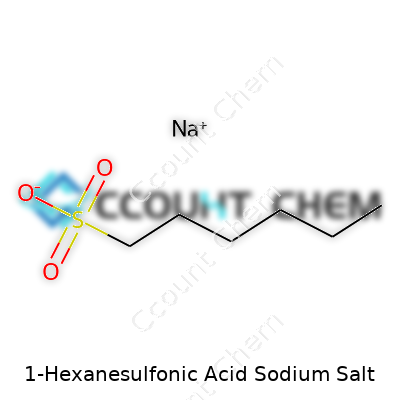
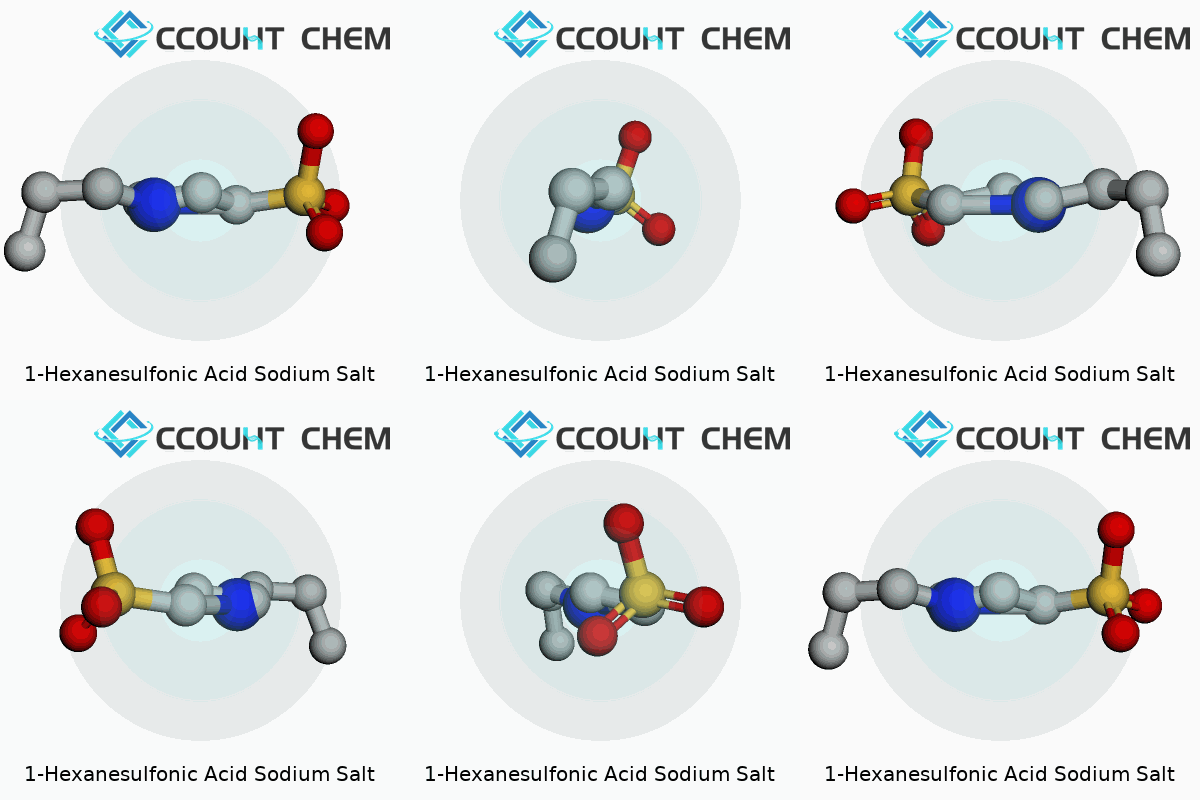
| Names | |
| Preferred IUPAC name | sodium hexane-1-sulfonate |
| Other names |
Sodium 1-hexanesulfonate 1-Hexanesulfonic acid sodium salt monohydrate Sodium hexane-1-sulfonate Hexanesulfonic acid sodium salt Hexane-1-sulfonic acid sodium salt |
| Pronunciation | /ˈwʌn ˈhɛk.seɪnˌsʌlˈfɒnɪk ˈæsɪd ˈsoʊdiəm sɔːlt/ |
| Identifiers | |
| CAS Number | 2832-51-1 |
| 3D model (JSmol) | `3D model (JSmol)` string for **1-Hexanesulfonic Acid Sodium Salt**: ``` CCCCC[S](=O)(=O)[O-].[Na+] ``` |
| Beilstein Reference | 1713887 |
| ChEBI | CHEBI:64333 |
| ChEMBL | CHEMBL444044 |
| ChemSpider | 19728 |
| DrugBank | DB04315 |
| ECHA InfoCard | 100.010.246 |
| EC Number | 2434-89-3 |
| Gmelin Reference | Gmelin Reference: **174213** |
| KEGG | C02324 |
| MeSH | D020071 |
| PubChem CID | 23665756 |
| RTECS number | GN7600000 |
| UNII | Y3J4YD1A8D |
| UN number | UN3265 |
| CompTox Dashboard (EPA) | DTXSID4054177 |
| Properties | |
| Chemical formula | C6H13NaO3S |
| Molar mass | 238.28 g/mol |
| Appearance | White to off-white powder |
| Odor | Odorless |
| Density | 1.22 g/cm³ |
| Solubility in water | Soluble in water |
| log P | -2.0 |
| Vapor pressure | Negligible |
| Acidity (pKa) | 1.5 |
| Basicity (pKb) | 12.52 |
| Magnetic susceptibility (χ) | -48.2e-6 cm³/mol |
| Refractive index (nD) | 1.440 |
| Viscosity | Viscosity: 15 mPa·s (20°C) |
| Dipole moment | 4.08 D |
| Thermochemistry | |
| Std molar entropy (S⦵298) | 340.6 J·mol⁻¹·K⁻¹ |
| Std enthalpy of formation (ΔfH⦵298) | -1100 kJ/mol |
| Std enthalpy of combustion (ΔcH⦵298) | -3860 kJ/mol |
| Pharmacology | |
| ATC code | V03AX |
| Hazards | |
| Main hazards | Causes skin irritation. Causes serious eye irritation. May cause respiratory irritation. |
| GHS labelling | GHS labelling: "Warning; H315, H319, H335; P261, P305+P351+P338 |
| Pictograms | GHS07, GHS05 |
| Signal word | Warning |
| Hazard statements | H315, H319 |
| Precautionary statements | Precautionary statements: P261, P280, P305+P351+P338, P304+P340, P312 |
| NFPA 704 (fire diamond) | 1-2-0 |
| Flash point | > 230 °C |
| Lethal dose or concentration | LD₅₀ (oral, rat): 2340 mg/kg |
| LD50 (median dose) | LD50 (median dose): Oral rat LD50: >2000 mg/kg |
| PEL (Permissible) | Not Established |
| REL (Recommended) | 0.2 mg/m³ |
| IDLH (Immediate danger) | Not listed |
| Related compounds | |
| Related compounds |
Hexanesulfonic acid 1-Hexanesulfonic acid Sodium dodecyl sulfate Sodium octanesulfonate Sodium decanesulfonate Sodium heptanesulfonate |



