


The story of 1,1,2,2,3,3,4,4,4-Nonafluorobutane-1-sulphonic acid, often referred to in research circles as PFBS (perfluorobutanesulfonic acid), stretches back decades, right alongside the broader journey of perfluoroalkyl substances. Chemical companies rolled out these compounds in the post-World War II drive for new, resilient materials. Demand for nonstick cookware, stain-resistant fabric, specialized firefighting foam, and weather-proof coatings sent chemists searching for molecules with backbone stability and chemical laziness. Long-chain “forever chemicals” like PFOS and PFOA captured markets first, but environmental and health concerns forced both regulators and producers to turn to shorter-chain options like PFBS. Industry positioned PFBS as a next-generation solution. Even as the science played catch-up, the compound filtered into various products as companies searched for ways to juggle performance with growing public scrutiny over pollution and toxicity.
PFBS carries a strong reputation for its resistance to heat, acids, bases, and biological attack. It does what polyfluorinated compounds do best: repels water, dirt, oils, and resists breakdown from sunlight or other environmental forces. For a time, that looked like an advantage with no downside. Formulators added PFBS to firefighting foam, mist suppressants, and even some consumer packaging that needed oil-barrier properties. The very resilience that made it attractive, though, became a sticking point as studies showed it lingered in soil and water just like its longer-chain predecessors. Companies found themselves weighing those classic tradeoffs of utility versus responsibility, especially as environmentalists kept the spotlight on newer PFAS family members like PFBS.
PFBS shows the classic traits of a perfluorinated molecule: a colorless liquid or sometimes solid at room temperature, dissolves easily in water, and displays extremely strong carbon-fluorine bonds throughout its structure. Its chemical formula, C4F9SO3H, tells a story of nine fluorines wrapping around a four-carbon backbone, pairing with a sulfonic acid group famous for providing both hydrophilic and hydrophobic qualities. The compound won’t evaporate much under typical conditions—a vapor pressure under 2 Pa at 20 degrees Celsius keeps it close to the ground or water surface. The acid group grants it strong acidity, and that means it interacts readily with bases but shrugs off oxidation or reduction reactions that would crumble lesser molecules. Its density, refractive index, and solubility, all precise and measured, give chemists predictable parameters to work with, which is part of why industry trusts it.
Suppliers sell PFBS in a range of purities that usually top out at 98% or higher, mostly as aqueous solutions or neat liquids, labeled thoughtfully with GHS pictograms for corrosivity and aquatic hazard. Safety data sheets spell out the hazards—significant eye and respiratory irritation on contact, acid burns with spillages, and persistent risk to aquatic life even at low concentrations. Each shipment comes tagged with the CAS number 375-73-5, chemical identifiers for transportation, UN shipping regulations where relevant, and directions for storage—typically away from incompatible strong bases, in well-ventilated storage away from metal or moisture. Regulatory bodies in the EU, US, and Asia place strict constraints on labeling, in step with the modern concern for transparency and hazard communication.
PFBS takes shape in the lab through an electrochemical fluorination route. This process involves butanesulfonyl fluoride or a similar hydrocarbon substrate, immersed in liquid hydrogen fluoride, subjected to high voltage current in a nickel cell. What leaves the cell is almost pure perfluorobutanesulfonyl fluoride, which then transforms through hydrolysis and acidification into the strong acid form. No one chooses this process for its environmental gentleness—the syntheses inherently release byproducts like perfluorinated tertiary amines and demand careful containment. Companies constantly tweak the workflow to cut waste streams and reduce fugitive losses, but the fundamental fluorination chemistry doesn’t easily bow to “green” upgrades.
PFBS resists most chemical attacks. Only the sulfonic acid group shows reactivity under normal conditions. Acids like this pair up with amines to build surfactants, react with metal salts to make antifouling agents, and act as catalysts in specialty polymerizations. Conversions focus on swapping the acidic hydrogen for metal cations, or occasionally attaching the sulfonyl group to organic backbones, opening the door for niche pharmaceuticals or ion-exchange media. These modifications rarely alter the perfluorinated main chain—it’s difficult and expensive to break a C-F bond—so most downstream chemistry relies on the group attached to the sulfonic end. Industrial users care about this: the molecule does not “wear out” quickly and stays in working fluids, sometimes for months or years on end.
PFBS wheels through the chemistry world with a set of alternative handles: perfluorobutane sulfonic acid, nonafluorobutane sulfonic acid, and in some product lines by trade names that suggest its four-carbon, fully fluorinated backbone. Formulators might spot it in ingredient lists as C4F9SO3H or by its CA index name. As substitute for longer-chain PFOS, some labels mark it as PFBS-K for its potassium salt, or PFBS-Na for the sodium variant, both common commercial forms for easier handling and application.
Keeping PFBS out of the wrong places takes deliberate work. Protective gloves, face shields, and acid-resistant aprons stay on the list of required gear. All handling gets routed through acid-resistant containment, with forced ventilation to avoid inhalation hazards. Workplaces implement regular spill response training, acid neutralization protocols, and mandatory reporting to environment health and safety officers. Agencies like OSHA and REACH set occupational exposure limits, though guidelines evolve alongside new health studies. Local and international authorities flag PFBS for environmental monitoring, requiring wastewater treatment plants and municipal water suppliers to test for trace-level contamination. Responsible suppliers track every shipment, using barcoded inventory systems so they know exactly how much material rests in storage or flows down a processing line.
PFBS fills gaps left by phased-out perfluorooctane sulfonates. Its core employment shows up in firefighting foams that prevent fuel vapor ignition on airport runways, in metal-plating baths where it controls mist and provides stable surface tension, and in certain specialty paper coatings for fast food wrappers and other applications demanding both grease resistance and water repellency. Tech companies chase its ionic conductivity, using PFBS salts to tune the properties of lithium batteries and electrolytic capacitors. Textile finishers use it less than its ancestors, but some industrial uniforms and outdoor gear still rely on its stain resistance in jurisdictions where rules allow. Its shorter carbon chain brought promises of more rapid elimination from the environment, but users keep an eye on mounting evidence for bioaccumulation in certain contexts.
R&D efforts around PFBS focus on two main tracks: understanding its environmental behavior and creating alternatives or improvements. Ongoing projects measure how PFBS moves through soil, water, and living organisms, teasing out the differences from legacy PFAS chemicals. Scientists build new filtration media tailored to snag short-chain PFAS like PFBS from industrial and municipal wastewater. Universities partner with health agencies to track PFBS levels in blood samples from exposed workers and community members, seeking biomarkers or health trends. On the innovation side, chemists test “next-generation” surfactants built with shorter fluorinated chains, add degradable groups, or switch to non-fluorinated alternatives where chemistry allows. Trade secrets wrap around these efforts, since whoever finds the right balance of performance and environmental fit stands to capture large swathes of the chemical supply chain.
Toxicologists lead the conversation on PFBS. Laboratory animals given high PFBS doses show signs of thyroid disruption, kidney stress, and possible effects on reproductive health, with some differences between rodents and primates hinting at complex toxicokinetics. Human exposure data remain incomplete, but biomonitoring shows PFBS appears in blood, breast milk, and even some food samples near industrial sites. Compared to long-chain PFAS, PFBS clears faster in mammals, yet small-scale human studies indicate it still lingers for weeks or months, raising concerns for communities with chronic exposure. Regulators respond with both drinking water standards and lowered reference doses for occupational exposure. Scientists continue to debate the threshold for “safe” levels, with some advocating for a precautionary stance given gaps in understanding long-term impacts.
The road forward for PFBS shines a spotlight on the classic tension between industry needs and environmental protection. Calls for global phase-out of persistent PFAS grow louder with each scientific paper linking residues to health woes. Some countries push strict bans or binding treatises, while others tap the brakes, hunting for alternatives that match the unique blend of toughness and specialty performance only perfluorinated acids bring. Innovation inches forward: researchers help design molecules that mix fluoroalkyl segments with hydrolyzable links, breaking down in the wild far quicker. Regulatory frameworks keep evolving, setting benchmarks no one considered just a decade ago. For suppliers and downstream users, the message rings clear: embrace transparency, invest in new chemistries, and own up to legacy impacts—or risk losing trust in markets that increasingly demand both high performance and health-first sourcing. PFBS may never stir the kind of public outcry that haunted earlier “forever chemicals,” but it sits squarely in the eye of the storm over sustainable progress in the chemical industry.
Anyone who’s done hands-on work in a laboratory or spent time in industrial chemical settings has noticed the reliance on specialty surfactants and agents to keep complex processes moving smoothly. One of those agents, with a name that won’t exactly roll off your tongue—1,1,2,2,3,3,4,4,4-Nonafluorobutane-1-Sulphonic Acid—shows up in places most people would never expect, like modern electronics manufacturing and some industrial cleaning jobs.
Behind every sturdy smartphone or razor-thin television screen, production steps depend on compounds that can handle extreme situations. 1,1,2,2,3,3,4,4,4-Nonafluorobutane-1-Sulphonic Acid offers superior resistance to breakdown from acids, bases, and heat. Fluorinated chemicals like this one lets circuit boards and semiconductors get cleaned or etched without the kind of residue you get from lower-grade surfactants. Years ago, more traditional acids would break down or leave contamination in fine pathways etched into chips, leading to device failures that a consumer would never trace to a production line. Now, the adoption of these fluorinated agents supports better yields and, in my own experience, less waste during processing.
Factories and large-scale cleaning operations run into grime and grease that water-based solutions simply can't budge. The powerful sulfonic acid group on this molecule interacts with greasy residues where older solvents used to fall flat. That means heavy-duty cleaning in metal finishing, aerospace, and even some parts of automotive manufacturing. Since many common detergents just smear grime or corrode sensitive components, the cleaner results from this compound help equipment last longer and get ready for the next round of work more reliably.
Growing up near a manufacturing corridor, I’ve watched riverbanks turn odd colors during the wrong parts of the year. Fluorinated chemicals caught headlines lately, especially for their persistence in water and the environment. 1,1,2,2,3,3,4,4,4-Nonafluorobutane-1-Sulphonic Acid falls into that larger family of PFAS substances—per- and polyfluoroalkyl substances. These “forever chemicals” show up in studies everywhere, from polar ice to city tap water, due to their resistance to breaking down. Scientists have connected the presence of PFAS chemicals to potential health problems, such as hormone disruption and certain cancers, leading some states and countries to rethink regulations.
Factories seeking alternatives have started exploring new surfactants and solvent systems with shorter environmental lifespans or different breakdown pathways. It’s an ongoing process that involves both research and hands-on process changes. On top of that, efforts to improve waste management—including closed-loop recycling and advanced filtration—help keep these tough chemicals out of rivers and groundwater. Workers lucky enough to be on teams focused on safer chemical handling already know the importance of thorough training and monitoring practices in reducing direct exposure risks.
One challenge facing both industry professionals and regulators is finding a middle ground between keeping modern conveniences affordable and maintaining accountability for the long-term health of communities. The lessons learned from using materials like 1,1,2,2,3,3,4,4,4-Nonafluorobutane-1-Sulphonic Acid underscore the need for balance. Whether building safer electronics or cleaning shipyards, choosing chemicals needs more than performance stats—it needs thoughtful oversight and an eye on the big picture.
1,1,2,2,3,3,4,4,4-Nonafluorobutane-1-sulphonic acid falls under the family known as PFAS, short for per- and polyfluoroalkyl substances. If you’ve ever read about “forever chemicals,” you’ve heard about PFAS. These compounds gained that nickname because they stick around, not just in the environment but also in the human body. Industries have put PFAS chemicals to work in everything from firefighting foams to the coatings on non-stick pans. The real problem starts with what makes these chemicals useful: they resist heat and repel water or oil. That same resistance means they tend to stay put once they’re out in nature.
Science has started piling up against PFAS, showing clear links to kidney cancer, thyroid disruption, weakened immune systems, and reproductive problems. This particular acid, with its long name and longer chain of carbon and fluorine atoms, acts in ways similar to other notorious PFAS. Researchers have found that most PFAS migrate easily — they run off into water, pass through soil, and wind up on dinner tables. No one is boiling down 1,1,2,2,3,3,4,4,4-nonafluorobutane-1-sulphonic acid in a home lab, but industries handle it in bulk.
I once spoke to a former industrial chemist from a large plant in the Midwest. For years, he brushed off chemical exposure, trusting the gloves and filters issued by the management. Now in his fifties, his blood has traces of several PFAS, including compounds from the same chemical class as this. Many workers from his team share similar experiences. In places where regulations lag, the comfort of belief often meets the cold facts of exposure.
Unlike chemicals that degrade under sunlight or in the ground, PFAS keep circulating. Rain can wash particles from distant factories into streams and soil. Aquifers draw in these contaminants and pass them into public water systems. More than 200 million Americans drink water with at least some PFAS contamination. This acid is no different — it’s slippery, tough, and hard to track down once it escapes into the wild.
Most people don’t have the power to ban chemicals outright. Still, individuals can call for stronger regulations and support local efforts for better water testing. Community groups in states like Michigan and North Carolina have shown real progress by sharing information, pushing for cleanup, and voting out officials who ignored early warnings.
There’s no magic fix, but practical steps can make a dent. Factories must adopt closed-loop systems, so any chemicals used get recycled instead of released. Filters such as activated carbon and reverse osmosis can clean many PFAS out of tap water. Local governments can put stricter limits on dumping and invest in cleanup. Each layer of accountability, from the factory floor to the kitchen sink, slows the spread.
Few people can pronounce 1,1,2,2,3,3,4,4,4-nonafluorobutane-1-sulphonic acid, but plenty will recognize the frustration of worrying about unseen chemicals. If society raises awareness, backs sensible regulations, and invests in practical solutions, it’s possible to protect communities from long-lasting hazards — even ones with names no one wants to say aloud.
In most labs, chemicals pile up fast. Over years in chemistry, I learned that tough chemicals often cause more trouble from poor storage than bad usage. 1,1,2,2,3,3,4,4,4-Nonafluorobutane-1-Sulphonic acid, or NFBSA, brings plenty of challenges for labs trying to stay safe and organized. This compound, with its mouthful of a name, doesn’t just call for a clear shelf and a closed cap like table salt would.
Mistakes with strong acids often lead to ruined containers, risky vapors, or even ruined experiments—stuff I’ve seen derail weeks of work or send someone to the safety shower. Getting storage right saves time, money, and sometimes keeps you off the hospital bill.
NFBSA acts like other perfluorinated acids—corrosive, persistent, and often unfriendly to careless setups. Corrosion isn’t only about clean-up, either; it means fumes that can eat at metals or mess with nearby electronics. Glass bottles keep this stuff where you put it, but plastic containers—unless they’re made of high-grade fluoropolymers like PTFE—don’t last. Regular polypropylene or cheap plastic warps, cracks, and sometimes leaks before you even see a problem.
Organic solvents and plastics react in odd ways with strong acids loaded with fluorine. So, sticking with glass or PTFE keeps the shelves cleaner and your air easier to breathe. Avoiding steel shelves or bins near storage keeps things from rusting or weakening over months.
I’ve run into labs where temperature swings turned safe acids into pop-bottle grenades. NFBSA doesn’t blow up, but high heat leads to pressure buildup or container rupture. I always opt for cool, consistent rooms—mid-20s Celsius at most. Sunlight shouldn’t get anywhere near these jugs, since some chemicals photodegrade or trigger container failure over long stretches.
Humidity also raises the stakes. Acids like NFBSA absorb water from the air if the caps aren’t tight, and diluted acid gets less predictable in reactions and more unpredictable for storage time. I keep everything in a dry box, with silica gel nearby, or at the very least make sure the container remains sealed tight between uses.
Spills with NFBSA travel far—its vapor isn’t friendly if it gets loose. Air circulation needs to push fumes outside, not toward people or other stored reagents. Storing this acid on a dedicated corrosion-proof spill tray adds an extra layer of peace of mind. Acid-neutralizing granules, not just baking soda, must be within reach.
Labeling can’t get skipped. Handwritten sharpie labels fade or rub off, and nobody wants surprises during inventory. Clear, printed labels with hazard warnings mean less guesswork for anyone grabbing supplies later.
Perfluorinated chemicals often sit in a regulatory spotlight. Keeping an up-to-date inventory means less accidental overstock and fewer expired bottles haunting the chemical closet. Local regulations for perfluorinated compounds can be stricter than general hazardous waste, pushing labs to plan for regular disposal by certified handlers.
Routine checks for leaks, bottle cracks, or crusted caps catch problems before cleanup grows expensive. Rotating stock—using older material before opening new—reduces waste and keeps the storeroom sane.
Chemical suppliers now offer standardized secondary containment bins sized for common bottle sizes. These containers cost a bit more upfront, but they dodge far bigger headaches later. Investing in a temperature-controlled chemical cabinet with built-in ventilation proves worth it, especially in busy city labs or small startups without full-scale fume hoods everywhere.
Regular training also helps. Even people with years under their belt forget best practices until a training session jogs the memory or a minor accident reminds everyone what’s at stake.
Any lab, from university to factory, benefits from clear storage protocols for nasty acids like NFBSA. With the right bottles, bins, dry rooms, and labels, risks shrink. That means more time for research, less budget on band-aids, and a better night’s sleep for everyone with a stake in safe lab science.
There’s more to chemistry than memorizing strings of letters and numbers. Each molecular formula holds the key to how compounds behave around us—what they build, how they break down, and especially, the impact they have on our health and planet. Dive into 1,1,2,2,3,3,4,4,4-Nonafluorobutane-1-sulphonic acid, a mouthful of a name that hides a potent blend of carbon, fluorine, sulfur, oxygen, and hydrogen.
If you break it down, this acid has nine fluorine atoms slapped onto a four-carbon chain, finished off with a sulfonic acid group. You end up with C4F9SO3H. That’s four carbons, nine fluorines, one sulfur, three oxygens, one hydrogen.
That many fluorines signals something serious: we’re talking about perfluoroalkyl substances, a group that includes notorious compounds like PFOS and PFOA. These aren’t just another set of everyday chemicals; they’re built to last, so much so that chemists call them “forever chemicals.”
Think about water that doesn’t wet, pans that don’t stick, fire-fighting foam that smothers in seconds—perfluorinated compounds made all of that possible. But as I dug into the science, it became obvious that the traits making these substances so useful—chemical stability and resistance to breakdown—end up haunting us in our soil, water, and even our blood.
Try searching “PFAS levels near me.” You’ll start to see stories: families with contaminated wells, cities facing costly cleanups, doctors raising red flags about possible health links to high cholesterol, thyroid disruption, and some cancers. Researchers warn that even low levels could build up over time. Recent EPA risk assessments have set drinking water limits so low they’re measured in parts per trillion, a billion times lower than the concentration of salt in sea water.
People often ask, “If these chemicals stick around forever, what are we supposed to do?” It takes a layered approach. Water utilities fight PFAS with activated carbon and advanced resins. Lawmakers debate phasing out products that use these molecules. Scientists hustle to invent next-gen materials that break down safely. Companies test replacements that won’t linger in landfills or leach into reservoirs.
One thing stays clear: you need the right formula in order to spot and track these substances in the wild. Testing labs use formulas like C4F9SO3H to search for contamination and identify breakdown products. If you don’t nail down the formula, cleanup plans fall apart—and mistakes can be costly.
I’ve seen firsthand how confusion over chemicals can leave communities struggling for answers. Precise naming and formulas aren’t classroom trivia. They drive research, regulation, and public trust. That’s the difference between “forever” substances that keep building up and solutions that actually solve the problem.
Keeping track of these details might sound like something for lab coats and chalkboards, but knowing what’s in a name—or a formula—shapes choices in products, influences laws, and protects families. People deserve the facts, plain and simple. Chemical literacy cuts through confusion, helps communities push for cleaner water, and reminds us why formulas like C4F9SO3H matter at all.
A lot of industries use substances with odd names, and 1,1,2,2,3,3,4,4,4-Nonafluorobutane-1-sulphonic acid is a mouthful that pops up in plenty of research. People mostly spot it in settings where high-performance, durable chemicals are needed. Think chemical manufacturing, specialty coatings, maybe even firefighting foam development. Some folks may wonder why this one, among thousands, draws scrutiny—and the answer lands squarely on its chemical family and what that family has done in the past.
The main concern shows up in its name: all those fluorine atoms. Scientists have found that chemicals packed with fluorine-carbon bonds resist breaking down in nature. That means this acid, like other perfluorinated substances, can stick around in water, soil, and wildlife. The Environmental Protection Agency and international watchdog groups point to perfluorinated chemicals, or PFAS, as “forever chemicals.” My own reading tells me these compounds wind up in rivers and lakes, and municipal water plants struggle against them. Once they’re in the system, it becomes nearly impossible to get rid of them through regular treatment.
Nobody wants unknown compounds building up underneath the radar. Research on perfluorinated chemicals has linked them to liver problems, thyroid impacts, and changes in cholesterol in lab animals. Recent health studies have even found that PFAS can travel through food chains. So a chemical like 1,1,2,2,3,3,4,4,4-Nonafluorobutane-1-sulphonic acid, which lingers and travels with water, could affect anyone living downstream from a factory or landfill. It rarely makes splashy headlines, but over time these substances tend to show up in the places you least expect: groundwater, food, rain. There’s personal concern among people who work with them, too. Workers can carry traces home on clothes, shoes, or through air in the nearby neighborhood.
Communities face tough decisions. Municipal spending cannot stretch to cover endless new filtration systems. Large-scale cleanup efforts for PFAS cost millions—and people end up foot the bill, sometimes through taxes, sometimes in healthcare costs. Ordinary households notice stricter water warnings because these substances were allowed into the environment for years before the risks were well-understood. A mix of short-term industry decisions and long-term environmental responsibility led here.
Solutions take teamwork and planning. Scientists push for new ways to break up strong chemical bonds in contaminated sites, but these fixes don’t look cheap or easy. Some countries push for tighter controls, making companies switch to safer alternatives. More transparency in chemical supply chains helps. Public agencies need reliable ways to test for PFAS in the air, water, and food, which doesn’t happen overnight. Putting money behind safer processes and clear reporting can help people feel more confident about what’s in their backyard or on their dinner plate.
Years ago, many didn’t realize the long-term reach of synthetic chemicals. Now, with stronger science and clear examples, people see why it’s important to address these problems early. Every community wants to trust its water and land. Practical steps like limiting non-essential use, investing in monitoring, and supporting research into safer replacements matter. Solutions need to last just as long as these chemicals do.
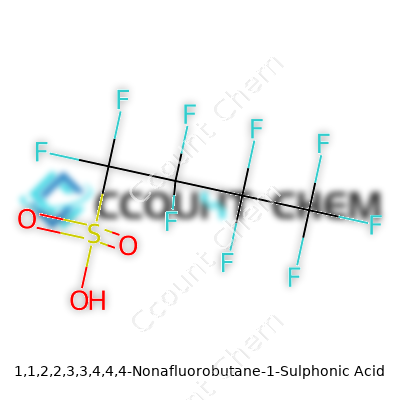
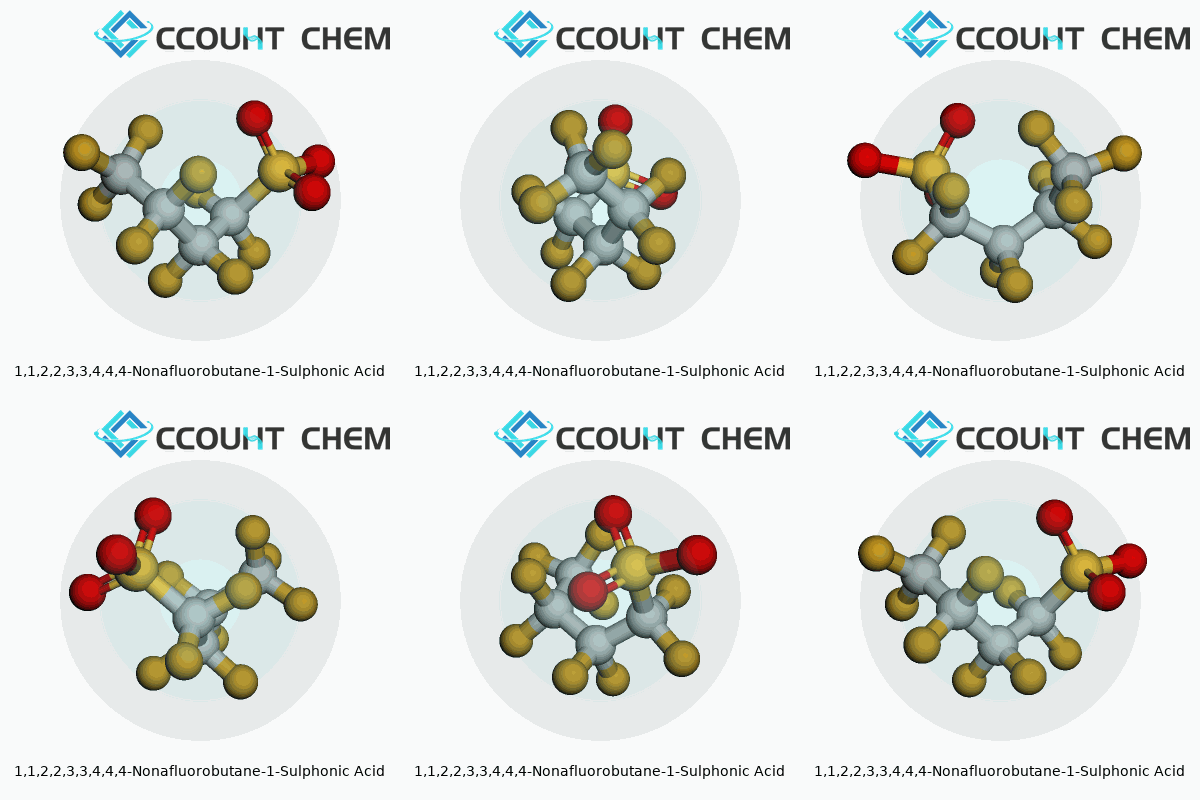
| Names | |
| Preferred IUPAC name | 1,1,2,2,3,3,4,4,4-Nonafluorobutane-1-sulfonic acid |
| Other names |
Perfluorobutane sulfonic acid PFBS Nonafluorobutanesulfonic acid 1,1,2,2,3,3,4,4,4-Nonafluorobutane-1-sulfonic acid |
| Pronunciation | /ˌnɒn.ə.fluəˌroʊ.bjuːˈteɪn wʌn sʌlˈfɒnɪk ˈæsɪd/ |
| Identifiers | |
| CAS Number | 375-73-5 |
| Beilstein Reference | 3638731 |
| ChEBI | CHEBI:85335 |
| ChEMBL | CHEMBL3112096 |
| ChemSpider | 22707176 |
| DrugBank | DB11274 |
| ECHA InfoCard | 03e6d05e-956e-4130-bbf3-7805dd3075e8 |
| EC Number | 206-195-3 |
| Gmelin Reference | 83294 |
| KEGG | C20842 |
| MeSH | D017358 |
| PubChem CID | 148244 |
| RTECS number | WS6635000 |
| UNII | 3B44DU65F5 |
| UN number | UN3272 |
| CompTox Dashboard (EPA) | DTXSID4041762 |
| Properties | |
| Chemical formula | C4HF9O3S |
| Molar mass | 350.11 g/mol |
| Appearance | White to off-white solid |
| Odor | Odorless |
| Density | 1.83 g/cm³ |
| Solubility in water | soluble |
| log P | -1.3 |
| Vapor pressure | <0.01 hPa (20 °C)> |
| Acidity (pKa) | -5.3 |
| Basicity (pKb) | -5.9 |
| Magnetic susceptibility (χ) | -32.0e-6 cm³/mol |
| Refractive index (nD) | 1.321 |
| Viscosity | 55.3 mPa·s (25 °C) |
| Dipole moment | 2.7287 D |
| Thermochemistry | |
| Std molar entropy (S⦵298) | 231 J·mol⁻¹·K⁻¹ |
| Std enthalpy of formation (ΔfH⦵298) | -1607.2 kJ/mol |
| Std enthalpy of combustion (ΔcH⦵298) | -1635.1 kJ/mol |
| Hazards | |
| Main hazards | Causes severe skin burns and eye damage. May cause respiratory irritation. Harmful to aquatic life with long lasting effects. |
| GHS labelling | GHS05, GHS07, GHS08 |
| Pictograms | GHS05,GHS07,GHS08 |
| Signal word | Danger |
| Hazard statements | H314: Causes severe skin burns and eye damage. H318: Causes serious eye damage. |
| Precautionary statements | P260, P273, P280, P284, P302+P352, P304+P340, P308+P313, P312, P363 |
| NFPA 704 (fire diamond) | 1-4-0 |
| Lethal dose or concentration | LD50 (oral, rat): >2000 mg/kg |
| LD50 (median dose) | LD50 (median dose): >2000 mg/kg (rat, oral) |
| NIOSH | DT8400000 |
| PEL (Permissible) | Not established |
| REL (Recommended) | 30 mg |
| IDLH (Immediate danger) | Not established |
| Related compounds | |
| Related compounds |
Perfluorooctanesulfonic acid Perfluorobutanesulfonic acid 1,1,2,2,3,3,4,4-Octafluorobutane-1-sulfonic acid 1,1,2,2,3,3,4-Heptafluorobutane-1-sulfonic acid Perfluorodecanesulfonic acid |



